.png)
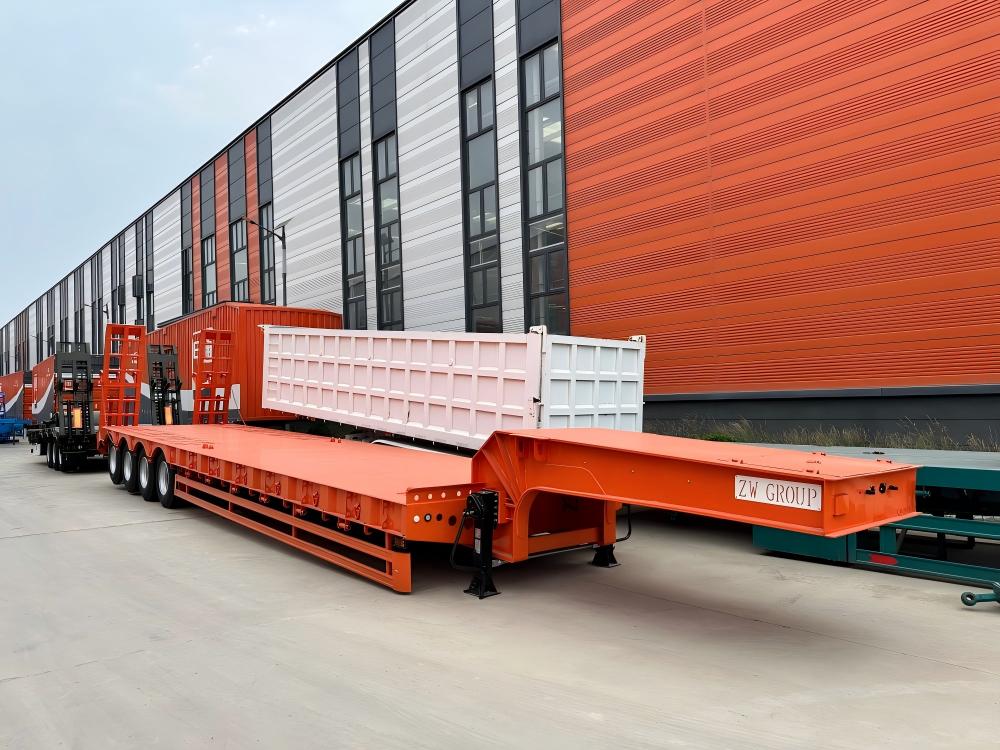

How to Choose the Right 4 Axle Lowbed Semi Trailer for Heavy Haulage
How to Choose the Right 4 Axle Lowbed Semi Trailer for Heavy Haulage
Maximize your cross-border fleet ROI, ensure strict axle-load compliance across East/West Africa and Central Asia, and eliminate premature tire wear with genuine FUWA/BPW structural engineering.
Cross-Border Heavy Haulage Requires Precision Engineering, Not Guesswork
Adding a 4 axle lowbed semi trailer to your heavy haulage fleet is a high-stakes capital investment. The return on investment (ROI) depends entirely on matching the legal axle-load restrictions of your transit corridors with the geometric dimensions of your high-frequency cargo. Blindly pursuing a “more axles means more payload” mindset creates operational bottlenecks, leaves valuable transport capacity underutilized, and exposes your logistics business to catastrophic cross-border customs fines and border clearance delays.
This comprehensive procurement manual breaks down the commercial selection model for 4 axle lowbed trailers from the perspectives of international fleet operations, full lifecycle asset depreciation, and regulatory road-right compliance. Whether you operate across the East African Community (EAC), ECOWAS, Central Asia, or Southeast Asian mining corridors, this guide outlines the structural indicators required to protect your bottom line.
1. Why the 4 Axle Lowbed Semi Trailer is the Sweet Spot for Multi-Country Transport
A 4 axle lowbed semi trailer, when coupled with a 6×4 heavy-duty prime mover, distributes the Gross Vehicle Weight (GVW) across 7 distinct axles. This configuration unlocks legal road rights for gross weights ranging from 60 to 80 tons across most nations in Southeast Asia, Central Asia, and Africa. Compared to standard 3 axle lowboys, the 4 axle architecture expands your legal payload space by more than 15 tons. This structural buffer converts illegal, high-risk overloading into compliant, high-margin revenue.
1.1 Cross-Border Road Regulations and Axle Load Constraints
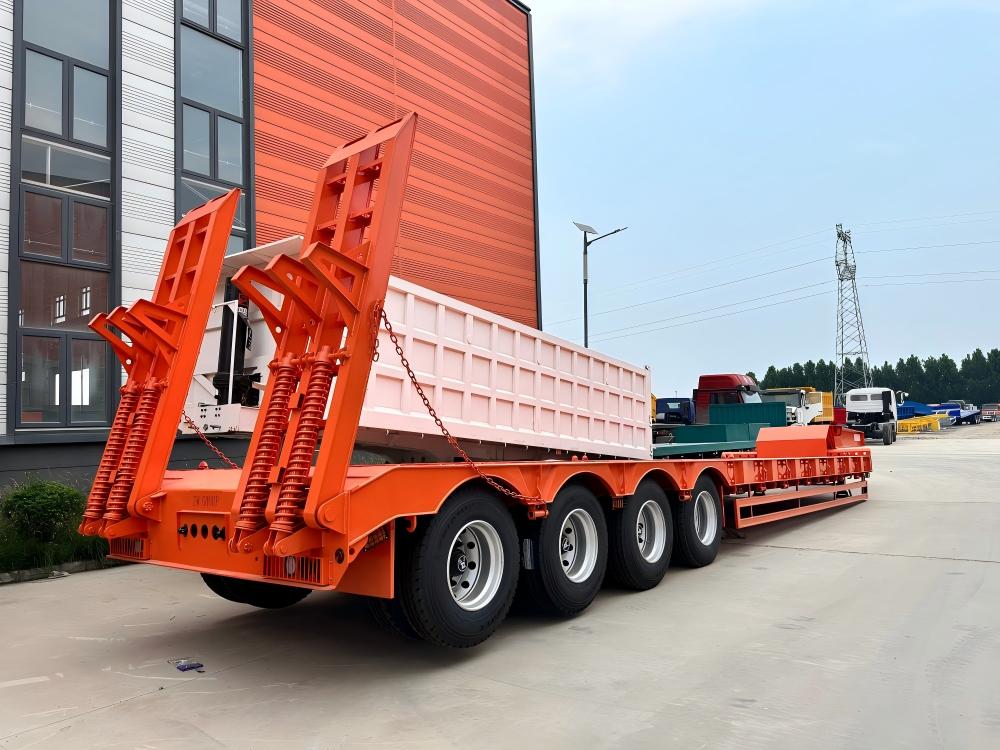
In the East African Community (EAC) and ECOWAS territories, fixed weighbridges enforce a maximum allowable single-axle load of 8 to 10 tons. Standard triple-axle assemblies frequently exceed these limits when transporting heavy yellow goods like large-scale excavators or drilling rigs. The 4 axle layout utilizes four sets of closely coupled, heavy-duty mechanical suspension systems. This configuration establishes a compliant load cluster under international transport laws, providing a reliable legal solution for long-distance cross-border transit.
1.2 Powertrain and Prime Mover Compatibility
To tow a 4 axle lowbed semi trailer rated for an 80-ton payload, your prime mover (such as a HOWO or SHACMAN heavy-duty tractor) must meet strict power thresholds. The engine output must not fall below 420 horsepower. The ideal configuration requires a 6×4 drivetrain equipped with a 16-ton double-reduction cast steel driving axle, paired with a reinforced 50# (2-inch) or 90# (3.5-inch) kingpin. This configuration prevents wheel slip and dangerous rollback when navigating unpaved mining access roads with grades exceeding 20%.
📊 Get a Free Powertrain & Fleet Matching Assessment
Our commercial advisory team brings over 10 years of experience in heavy truck and trailer joint export logistics. We provide complimentary powertrain and axle compatibility calculations tailored to your specific truck models and hauling routes.
Get Free Matching Sheet via WhatsApp: +86185609136652. Regulatory Framework: Axle Load Distribution Comparison
The table below illustrates how a 4 axle lowbed semi trailer optimizes weight distribution compared to a standard 3 axle configuration when hauling a 60-ton payload over public infrastructure.
| Trailer Type / Parameter | 3 Axle Lowbed Trailer | 4 Axle Lowbed Trailer (ZW Choice) | Operational Impact / Advantage |
|---|---|---|---|
| Rated Payload Capacity | 45 – 55 Tons | 60 – 85 Tons | Safely expands heavy cargo capacity by up to 30 tons. |
| Average Single Axle Load | 13.5 Tons (At 55T Payload) | 9.2 Tons (At 65T Payload) | Meets the strict 10-ton limits enforced at cross-border weighbridges. |
| Main Beam Structure | Single-layer Q345 Manganese | Double-layer HG60 High-Tensile | Prevents sagging, deformation, and structural cracking under concentrated loads. |
| Tire Stress Distribution | Uneven load, high risk of blowout | Uniform 16-tire balancing | Reduces local tire wear and extends tread life. |
| 5-Year Residual Resale Value | Under 20% original value | 40% – 45% original value | Commanding a premium of over $6,000 on the secondary market. |
3. Full Lifecycle Operating Costs: Premium Specs Drive Higher Residual Value
A high-ROI lowboy trailer must keep its total 5-year maintenance expenditures under 15% of the initial purchase price, while retaining a minimum 40% residual value on the secondary market. Achieving these metrics requires specifying heavy-duty components from the start. In international engineering and equipment leasing markets, a 4 axle lowbed built with genuine FUWA or BPW axles and a double-layered main beam retains a premium of at least $6,000 after four years of intensive service compared to unbranded, small-factory alternatives.
3.1 Genuine FUWA 16-Ton Axles vs. Unbranded Alternatives
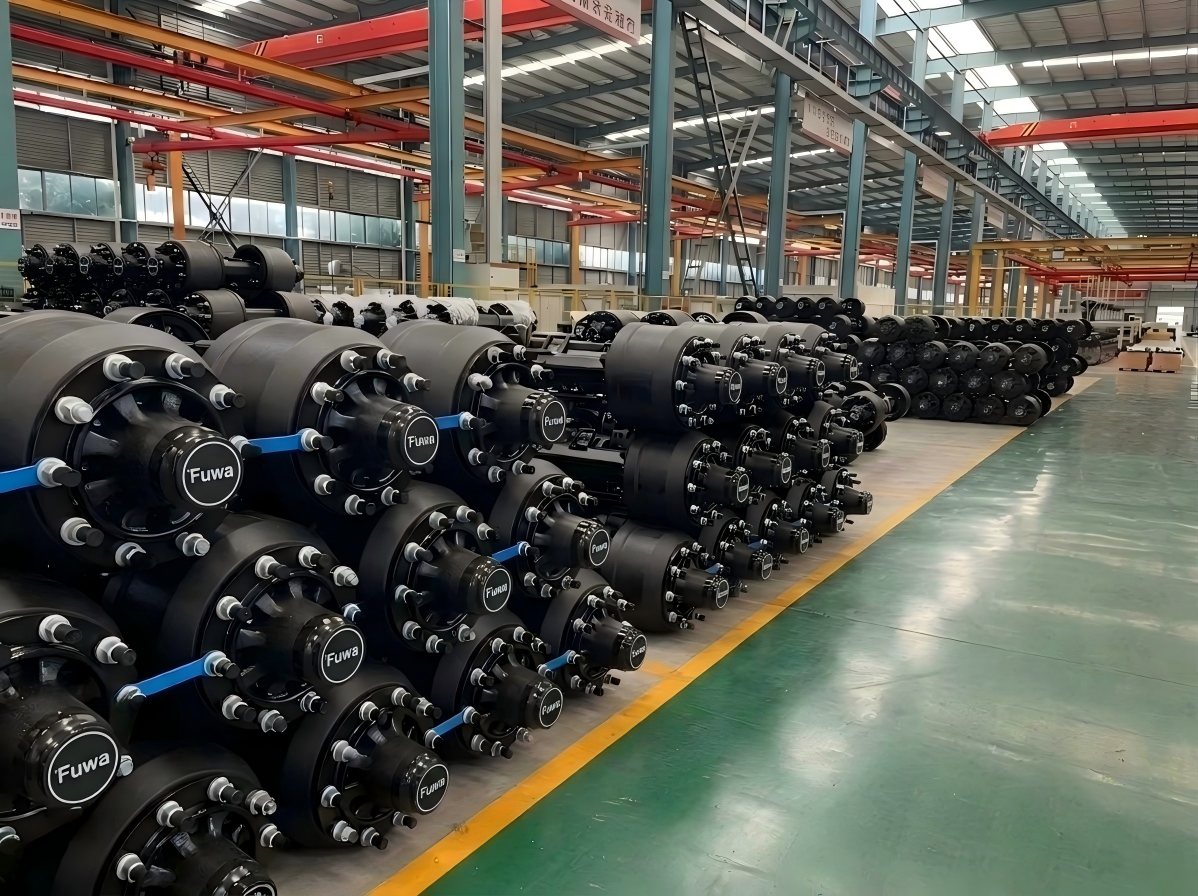
We recommend specifying genuine FUWA or BPW 16-ton heavy-duty braking axles. Avoid unbranded or refurbished axle assemblies. Genuine axles utilize a one-piece, heat-treated seamless steel tube design that resists bending under extreme loads. Furthermore, genuine brake linings deliver a service life up to 1.5 times longer than generic alternatives. The global availability of these spare parts simplifies maintenance and supports high liquidity in the secondary market.
3.2 Reinforced Mechanical Suspension for Tire Wear Control
Irregular tire wear is an ongoing operating expense for multi-axle trailers. A high-quality 4 axle lowbed must feature a mechanical suspension system using leaf springs with a minimum individual thickness of 16mm, stacked in configurations of 9 or 10 leaves per stack. This heavy-duty setup dampens shock loads from unpaved roads and balances the load across all 16 tires. Eliminating localized tire scrubbing can save your fleet the cost of up to two complete sets of replacement tires every 10,000 kilometers.
3.3 Kingpin, Landing Gear, and Hydraulic Ramp Systems
- Kingpin Selection: ZW Group utilizes heavy-duty JOST 90# bolted kingpins fabricated from high-grade chromium-molybdenum alloy steel, enabling rapid decoupling and cross-fleet interoperability.
- Landing Gear: JOST 28-ton dual-speed landing legs provide a static lift capacity of 80 tons, preventing sinking or collapsing during decoupled storage on soft staging ground.
- Hydraulic vs. Mechanical Ramps: For oversized crawlers, we install dual-acting heavy-duty hydraulic ramps powered by autonomous 12V/24V DC electric-hydraulic pump stations or auxiliary tractor power take-offs (PTO). These systems maintain loading angles below 14 degrees to ensure safe equipment boarding.
4. Functional Customization: Matching the Cargo Deck to Your High-Frequency Equipment
A lowbed deck layout must be engineered around specific machinery dimensions. Selecting a generic, off-the-shelf lowboy often introduces loading safety risks. Review your fleet’s historical manifest and identify core equipment categories with over a 60% transport frequency over the past two years to guide your custom specifications.
• Oversized Excavators (e.g., SANY SY365H, XCMG XE380E)
These tall, wide crawlers require a concave drop-deck layout with side extension brackets (outriggers). ZW Group designs heavy-duty pull-out or swing-out outriggers that extend the deck width by 250mm on each side, expanding the overall loading surface from 3.0 meters to 3.5 meters. This extension ensures the entire track width is supported, lowering the center of gravity by up to 300mm to maximize overhead clearance under bridges and power lines.
• Heavy Wheeled Machinery (e.g., Mining Tippers, Soil Compactors)
To counter loading slippage, the rear climbing ramp and beaver-tail deck should feature reinforced checker plate steel with a minimum thickness of 8mm, reinforced with welded horizontal anti-slip rebar grids (minimum 16mm diameter rebar). This design provides traction for steel-wheeled rollers and muddy off-road tires, preventing hazardous slippage during wet-weather loading operations.
• Electrical Transformers & Sensitive Industrial Modules
For fleets handling rigid, heavy electrical infrastructure components, we offer an automated front-axle air lifting system. When running empty on return legs, the front axle lifts completely clear of the asphalt. This reduction in rolling resistance cuts tire wear by 25% on the lifted axle and delivers up to a 3% savings in fuel consumption per 100 kilometers.
📋 Request Custom CAD Drawings & Direct FOB Quotations
Our manufacturing facility is located near Qingdao Port and Tianjin Port, offering direct access to international shipping lines. Send us your primary equipment models, weights, and outer dimensions via WhatsApp, and our engineering desk will deliver an optimized structural drawing and tiered pricing within 2 hours.
Submit Equipment Manifest via WhatsApp: +86185609136655. Operational Reality Check: ZW Group Quality vs. Low-Cost Alternatives
The difference between a high-specification heavy haulage unit and a cut-rate generic trailer becomes clear within the first six months of rugged site operations.
Standard Low-Cost Competitor Trailers
- Single-Layer Frame: Standard Q345 steel frames can sag or deform permanently under concentrated heavy payloads.
- Generic Axle Systems: Unbranded axles frequently suffer from spindle flexing and accelerated brake fade under heavy braking.
- Basic Leaf Springs: Non-standard 12mm suspension springs cause uneven tire alignment and premature tire wear.
- Standard Grade Coatings: Basic single-layer alkyd paints chip easily, accelerating rust under coastal or high-humidity conditions.
ZW Group Precision Built Trailers
- Double-layer main beams made from HG60 high-tensile steel prevent frame sagging.
- Genuine FUWA/BPW 16-ton axles offer reliable structural integrity and long-term durability.
- Reinforced 16mm thick, 10-piece mechanical leaf springs eliminate uneven tire wear.
- Polyurethane marine-grade primers and dual-coat top finishes protect against corrosion in maritime transit and tropical environments.
6. Standard Configurations for ZW Group 4 Axle Lowbed Semi Trailers
These blueprints outline the standard specifications for our export series 4 axle heavy-duty lowboy trailers. Custom dimensions can be accommodated by our design team.
| Technical Parameter | 60-Ton Capacity Variant | 80-Ton Capacity Variant | 100-Ton Heavy Duty Variant |
|---|---|---|---|
| Overall Length | 13,500 mm | 14,500 mm | 15,800 mm |
| Standard Width | 3,000 mm | 3,000 mm + 2x250mm Extensions | 3,200 mm + 2x250mm Extensions |
| Cargo Bed Height | 1,100 mm | 1,050 mm / 900 mm (Low Deck) | 850 mm (Ultra-Low Structure) |
| Axle Setup | 4x 13-Ton FUWA Axles | 4x 16-Ton FUWA Axles | 4x 16-Ton BPW Heavy Axles |
| Main Beam Dimensions | H: 500mm, Top:16mm, Bot:18mm | H: 550mm, Top:20mm, Bot:22mm | H: 550mm, Double-Plate Reinforced |
| Tire Specification | 11.00R20 (16 Units) | 12.00R20 Heavy Grade (16 Units) | 315/80R22.5 Tubeless (16 Units) |
| Brake System | WABCO Dual-Line Valve | WABCO ABS Dual-Line System | WABCO EBS Smart Brake System |
7. Expert Frequently Asked Questions (FAQ)
Here are detailed structural and commercial answers to the most common procurement questions we receive from international buyers.
Q1: What is the maximum payload limit for a standard 4 axle lowbed semi trailer?
A: Our standard configurations support structural payloads between 60 and 85 metric tons, with heavy-duty custom builds rated up to 120 tons.
Q2: How does a 4 axle configuration prevent penalties at cross-border weighbridges?
A: By adding a fourth axle, the gross weight is distributed across an additional load cluster, lowering individual axle weights below the strict 10-ton limits enforced in regions like East Africa.
Q3: Why choose genuine FUWA axles over generic unbranded ones?
A: Genuine FUWA axles use a heat-treated, single-piece seamless steel tube that resists deformation under continuous heavy loading while improving long-term resale value.
Q4: What grade of steel is utilized in the main chassis frame?
A: We use HG60 high-tensile steel, which offers a yield strength double that of standard Q345 manganese steel, preventing frame sag or cracking under concentrated loads.
Q5: Can the trailer width be adjusted for oversized mining machinery?
A: Yes, we integrate heavy-duty swing-out outriggers that extend the standard 3.0-meter deck width by 250mm on each side, creating a stable 3.5-meter loading platform.
Q6: What is the purpose of an optional front-axle air lift system?
A: It lifts the front axle during empty return journeys, reducing tire wear by 25% and cutting fleet fuel consumption by up to 3%.
Q7: What is the recommended minimum horsepower for the prime mover?
A: The towing truck should provide at least 420 horsepower, a 6×4 drive layout, and a hub-reduction axle to pull an 80-ton loaded trailer up steep grades.
Q8: How do you protect the steel chassis against marine corrosion during transit?
A: Every trailer undergoes sandblasting to SA 2.5 standards, followed by a zinc-rich epoxy primer and two coats of polyurethane topcoat to resist saltwater exposure.
Q9: Are standard replacement parts easy to source in Africa or Central Asia?
A: Yes, by using standard FUWA, BPW, and JOST components, replacement wear items like brake shoes and air bags are widely available worldwide.
Q10: What is the benefit of a double-plate main beam design?
A: It reinforces the center section of the chassis, preventing twisting and bending when heavy equipment passes over the rear ramps.
Q11: Do you offer hydraulic ramp configurations?
A: Yes, we provide automated heavy-duty hydraulic ramps powered by standalone electric-hydraulic pumps or direct tractor PTO lines.
Q12: Which kingpin size should be selected for heavy haulage operations?
A: We recommend a 90# (3.5-inch) JOST heavy-duty bolted kingpin for gross combination weights exceeding 60 metric tons.
Q13: What braking valves are integrated into the trailer assembly?
A: We install genuine WABCO RE-6 relay valves to maximize pneumatic response speeds and minimize emergency braking distances.
Q14: How is irregular tire wear minimized on your multi-axle trailers?
A: We utilize 16mm thick, 10-piece mechanical leaf springs combined with reinforced balancing arms to distribute loads evenly across all 16 tires.
Q15: What is the expected secondary-market residual value of these trailers?
A: Maintained units regularly command a residual value of 40% to 45% after 5 years of service, outperforming budget unbranded trailers.
Q16: Can the loading ramp angle accommodate low-clearance asphalt rollers?
A: Yes, we offer extended folding rear ramps that reduce the approach angle below 12 degrees to safely load low-clearance compaction gear.
Q17: What shipping options are available for delivery to West Africa?
A: We manage RO-RO (Roll-on/Roll-off) and bulk cargo shipping, and can also arrange containerized transport for knockdown modular builds.
Q18: How long does it take to get a customized technical drawing?
A: Our engineering desk can output tailored CAD blueprints within 2 hours of receiving your specific equipment requirements.
Q19: What thickness of deck flooring is used for tracked machinery?
A: We lay down 8mm heavy-duty anti-slip checkered steel plates, reinforced underneath with dense channel-steel crossmembers.
Q20: Do you provide a structural warranty?
A: Yes, ZW Group provides a 12-month comprehensive warranty covering the main structural chassis elements and major component interfaces.
8. Supply Chain Excellence: The ZW Group Global Export Protocols
As an established vehicle manufacturer located near major Chinese shipping hubs like Qingdao and Tianjin, ZW Group manages the complete export lifecycle to reduce risk for international buyers.
1. Structural Optimization
Our engineering desk reviews your machinery profiles to design appropriate wheelbase, outrigger, and ramp configurations.
2. Production Testing
Chassis welds undergo radiographic non-destructive flaw detection, followed by structural load testing exceeding 125% of rated capacity.
3. Marine Prep
Trailers receive an anti-corrosion marine wax coating before being secured in RO-RO or bulk carrier holds to manage maritime moisture.
4. Port Clearance
Our customs documentation team handles commercial invoicing, certificates of origin, and bill-of-lading processing for smooth arrival port clearance.
Related Heavy-Haulage Solutions from ZW Group
Explore our complementary heavy-duty transport options to optimize your fleet configurations:
- 3 Axle Lowbed Semi Trailers – Best for standard regional heavy haulage up to 50 tons.
- Extendable Wind-Blade/Tower Lowboys – Engineered for ultra-long industrial modules.
- Hydraulic Detachable Gooseneck (Front Loading) Trailers – Ideal for low-clearance mining equipment.
- HOWO 6×4 Prime Movers (420HP Series) – Properly matched towing power for multi-axle configurations.
Optimize Your Logistics Efficiency with ZW Group
Avoid underutilized transport capacity and costly overloading fines. Partner with our heavy manufacturing division to configure a durable, compliant 4 axle lowbed trailer tailored to your operations.
Direct Hotlines for Global Fleet Procurement & Engineering Consultation:
WhatsApp Messenger: +8618560913665
Email: info@zwgroup-vehicle.com | Response Matrix: Within 2 Hours
Good a blog toper