

Semi Trailer Chassis Guide: Steel, Axles, Suspension & Inspection
ZW Group | Semi Trailer Chassis Manufacturer
How to Choose a Semi Trailer Chassis: A Technical Guide to Strength, Payload and Service Life
A reliable semi trailer chassis starts with the right structural design, verified steel specifications, correctly rated axles and a running gear configuration suited to the actual transport conditions. For fleet operators, trailer dealers, importers and project contractors, these decisions directly affect payload capacity, maintenance requirements, vehicle availability and long-term operating costs.
When comparing manufacturers, do not judge a semi trailer chassis by appearance, overall weight or quotation price alone. Examine the main beam construction, flange and web plate dimensions, gooseneck reinforcement, crossmembers, axle assembly, suspension, braking system and manufacturing quality. The complete structure must work as an integrated system under the intended loading conditions.
ZW Group helps international commercial vehicle buyers evaluate semi trailer configurations for freight transport, construction materials, mining operations, container logistics and heavy-duty applications. This guide explains what to specify, what to inspect and which questions to settle before placing an export order.
WhatsApp ZW Group for Chassis SpecificationsWhat Is a Semi Trailer Chassis and Why Does It Matter?
The semi trailer chassis is the load-bearing frame that connects the trailer’s body or deck to its suspension, axles, landing gear and kingpin assembly. It transfers forces generated by cargo weight, braking, acceleration, cornering and road impacts throughout the vehicle structure. A poorly matched frame can create maintenance problems even when the trailer is fitted with reputable axles and tyres.
For a transport business, chassis selection is not simply a manufacturing detail. It determines whether the trailer is suitable for repeated loading cycles, uneven roads, long-distance operation and the specific cargo carried by the fleet. Structural strength, tare weight and serviceability must be evaluated together rather than treated as separate purchasing decisions.
Which Components Should Buyers Evaluate?
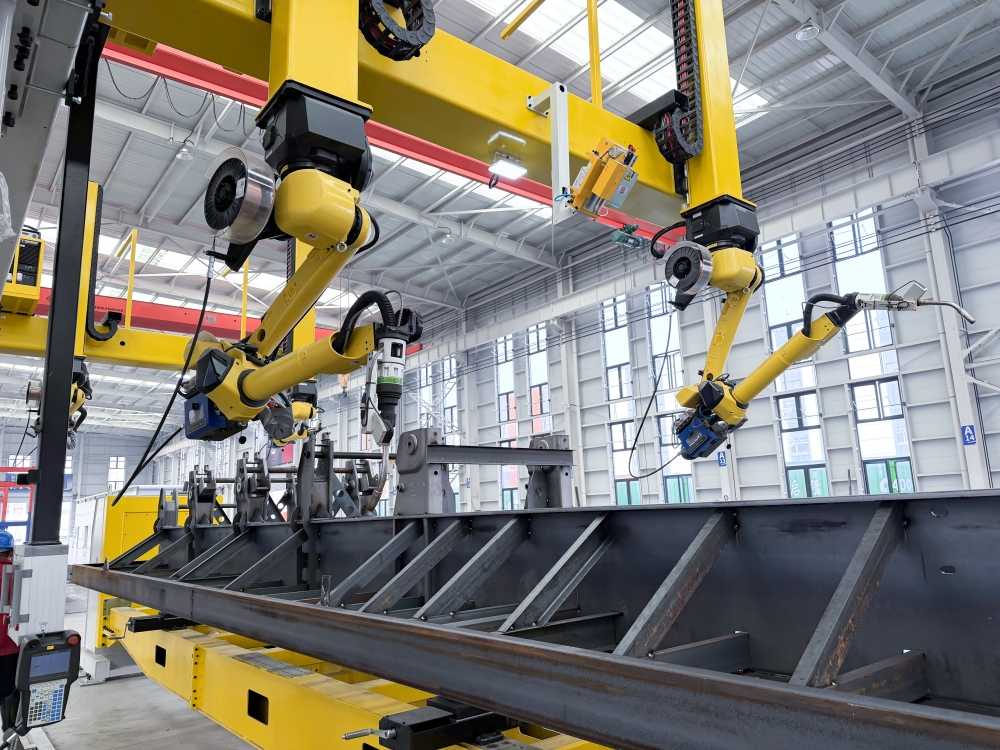
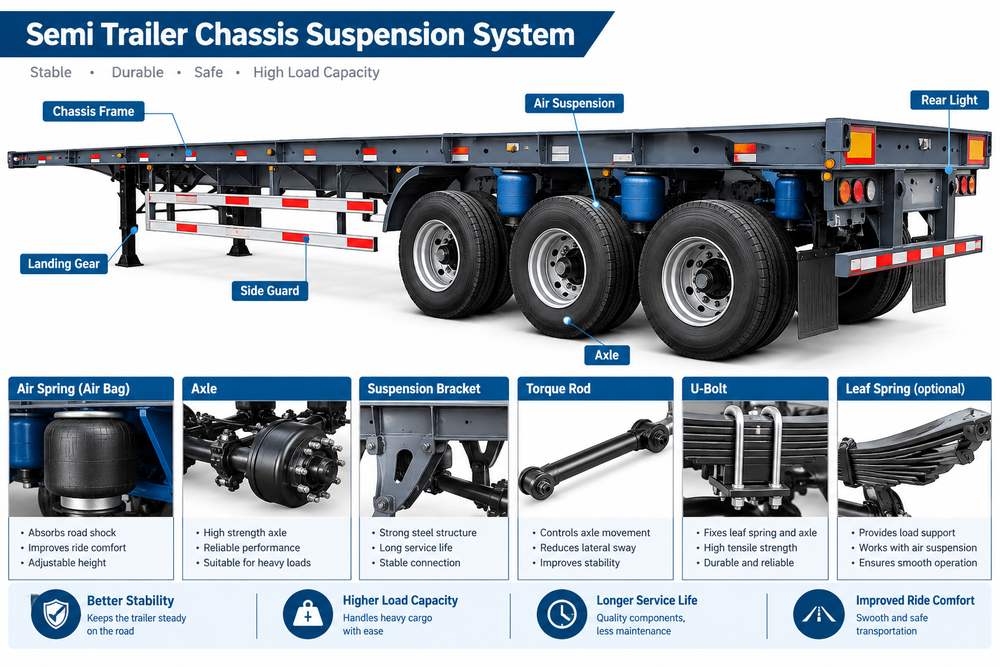
A commercial semi trailer chassis should be evaluated as a complete assembly. The main beams provide the primary longitudinal structure, while crossmembers help support and distribute deck or body loads. The kingpin and upper coupling area transfer forces to the prime mover. Suspension brackets, axle mounting points, landing gear supports and body attachment locations must also be designed for their intended loads.
- Main beams: Review steel grade, beam geometry, upper and lower flange dimensions, web thickness and reinforcement.
- Crossmembers: Confirm quantity, spacing, section design and connection quality against the approved drawing.
- Kingpin and coupling area: Verify dimensions, rated capacity and compatibility with the prime mover’s fifth wheel.
- Suspension mounting points: Check bracket design, alignment and suitability for the specified suspension and axle ratings.
- Landing gear supports: Confirm that the structure accommodates the specified landing gear and intended operating conditions.
- Welds and fasteners: Inspect accessible joints, weld continuity, fastening arrangements and visible manufacturing defects.
- Surface protection: Review surface preparation, coating coverage and protection of vulnerable areas according to the order specification.
The correct semi trailer chassis specification depends on cargo, payload distribution, road conditions, trailer type, prime mover compatibility and destination-market regulations. A chassis designed for highway freight may require a different structural configuration from a unit intended for heavy construction materials or demanding site operations.
Information to provide before requesting a quotation
Trailer type, cargo, target payload, cargo dimensions, operating country, route conditions, prime mover model, required chassis dimensions, axle configuration, suspension preference, braking requirements, order quantity and any mandatory technical or import specifications.
How Does High-Strength Steel Improve a Semi Trailer Chassis?
Steel grade and structural geometry influence how a semi trailer chassis responds to bending, shear forces and repeated loading. High-strength steel can allow engineers to achieve specified structural performance with an optimized design, but the result depends on the complete beam section, material properties, weld quality and manufacturing process. A steel grade alone does not establish the load capacity of a finished trailer.
The technical information supplied for this article identifies Baosteel high-strength steel as a material option and states that its strength can be more than 30% higher than ordinary Q235 steel. This should be treated as a source-provided comparison that requires verification against the exact material grade and mechanical-property standard. Buyers should request the actual steel designation and supporting documentation rather than assuming that all high-strength steels have identical properties.
Which Main Beam Dimensions Should Be Confirmed?
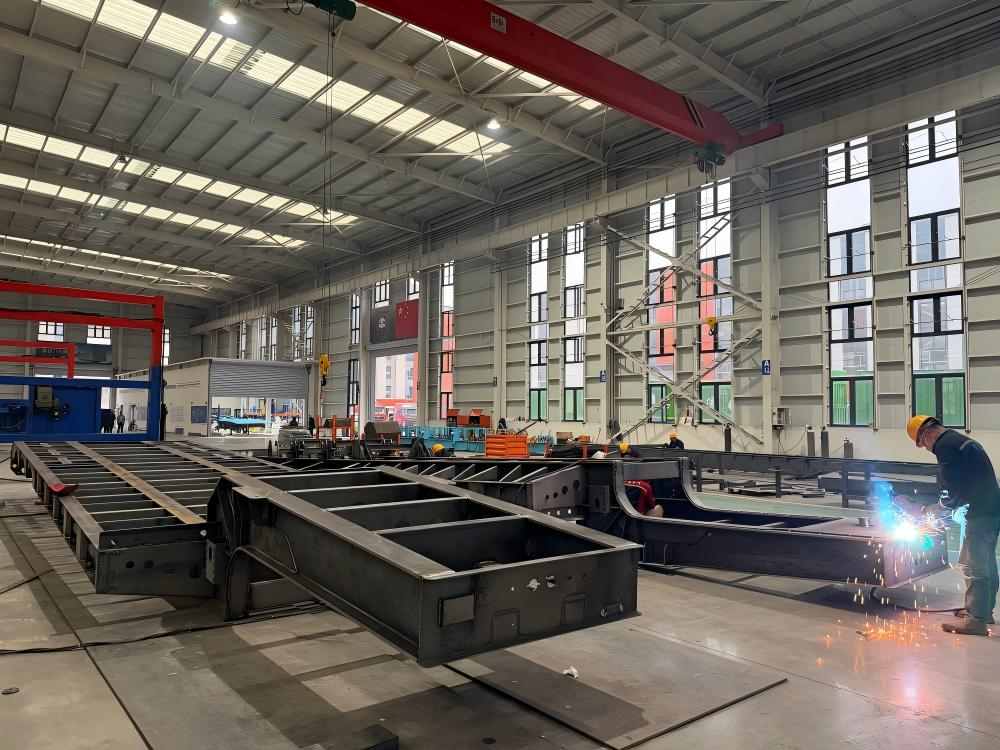
The longitudinal main beam is one of the most important elements of a semi trailer chassis. Its upper flange, lower flange and vertical web plate work together to resist bending and transfer loads. The appropriate dimensions depend on beam height, steel grade, cargo distribution, support locations, fatigue requirements and the intended duty cycle.
The source material provides the following reference configuration: an 8 mm upper flange, a 10 mm lower flange and a 6 mm web plate. These dimensions can help buyers understand a quotation, but they are not universal requirements for every trailer. The manufacturer must determine the appropriate design for the actual application.
| Chassis component | Reference detail | Buyer verification |
|---|---|---|
| Upper flange | 8 mm in the supplied reference configuration | Confirm specified thickness, steel grade and section dimensions. |
| Lower flange | 10 mm in the supplied reference configuration | Check dimensions and material documentation against the contract. |
| Vertical web plate | 6 mm in the supplied reference configuration | Inspect specified thickness, straightness and accessible welds. |
| Crossmembers | As defined by the approved chassis design | Verify number, spacing, section type and fastening. |
| Gooseneck transition | Reinforcement according to the trailer design | Check the approved drawing and inspect for visible cracks or unexplained splicing. |
When comparing two chassis quotations, ask each manufacturer to identify the steel grade, main beam dimensions, reinforcement arrangement and applicable drawing revision. A general description such as heavy-duty steel is insufficient for a technical comparison.
Plate thickness also needs to be distinguished from overall structural strength. A heavier section may increase tare weight, while a well-engineered section may use a different combination of geometry and material properties. The appropriate choice depends on the complete design, not one isolated measurement.
Why Does Gooseneck Reinforcement Matter?
On chassis designs with a gooseneck or a change in deck height, the transition area deserves particular attention. Geometry changes can influence local stress distribution, so reinforcement and fabrication quality must match the engineering design. This is especially relevant for trailers operating with heavy cargo, uneven surfaces or repeated loading cycles.
During inspection, compare the reinforcement arrangement with the approved drawing. Look for visible cracks, deformation, inconsistent welds and unexplained joints. If structural integrity is uncertain, arrange assessment by qualified personnel and suitable non-destructive testing where appropriate. A visual inspection alone cannot establish the condition of every internal or hidden weld.
How Do Axles Affect Semi Trailer Chassis Performance?
The axle assembly and chassis must be specified together. Axle rating, suspension geometry, tyre capacity, brake configuration and load distribution determine how forces are transferred from the road into the frame. Installing higher-rated axles does not automatically increase the legal payload or make an otherwise unsuitable chassis capable of carrying heavier cargo.
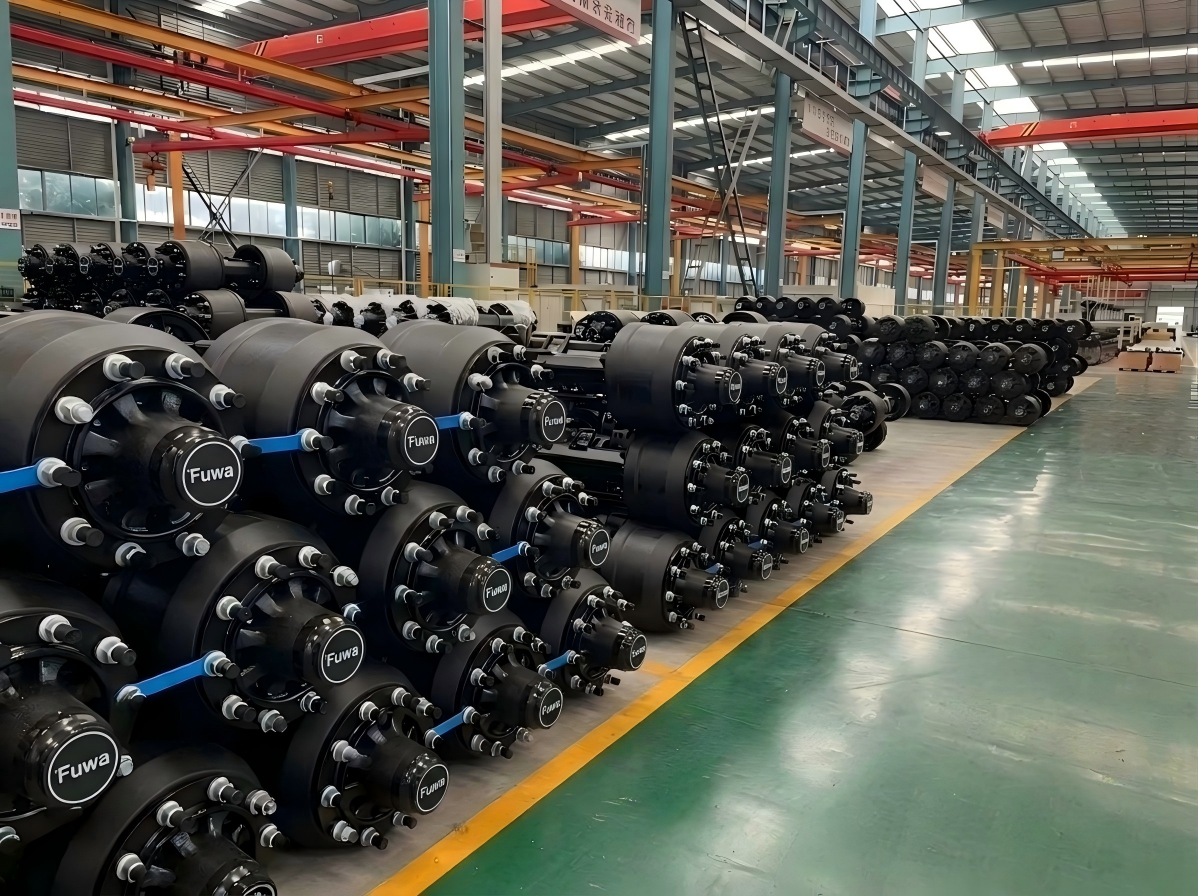
The supplied source identifies FUWA and BPW as established axle brands and recommends checking original product identification marks and anti-counterfeit codes where available. Buyers should confirm the exact manufacturer, model, rating and documentation stated in the quotation. An identifying mark is one verification point; it should be considered alongside supplier records and the agreed technical specification.
How Should You Evaluate 13-Ton, 16-Ton and 20-Ton Axles?
The supplied material describes 13-ton-class axles as a common option for long-distance transport, 16-ton-class axles as an option to evaluate for demanding heavy-load routes, and 20-ton-class or higher axles for heavy-duty engineering applications. These are reference points for discussing configurations, not universal recommendations. Rating definitions, component specifications and legal axle loads must be confirmed for the actual product and destination.
| Axle class | Application to evaluate | Technical checks |
|---|---|---|
| 13-ton class | Conventional freight operations where the complete vehicle meets the load requirements | Axle rating, tyre capacity, suspension compatibility and local axle-load limits. |
| 16-ton class | Potential candidate for demanding routes after engineering review | Brake specification, tyre rating, frame design and load distribution. |
| 20-ton class or above | Specialized heavy-duty applications requiring a complete system assessment | Documented ratings, approved design and compliance with applicable limits. |
A semi trailer chassis must distribute the cargo load appropriately across the axle group and kingpin. The actual load at each axle depends on the trailer geometry, coupling position, cargo centre of gravity and loading pattern. A nominal axle rating cannot be used as a substitute for a complete load-distribution assessment.
Before ordering, confirm axle spacing, suspension type, wheel and tyre specifications, brake components and replacement-part availability. For export fleets, the practical ability to source seals, bearings, brake components and other service items can affect vehicle uptime over the life of the trailer.
When a supplier proposes an alternative axle brand or model, require written approval before production. The replacement should be checked for rating, dimensions, mounting compatibility, braking performance and parts support rather than accepted on price alone.
Which Suspension System Is Suitable for Your Chassis?
Suspension selection should reflect cargo, road conditions, operating frequency, maintenance capability and the required ride characteristics. Leaf-spring suspension is often considered for demanding work where a straightforward mechanical arrangement and practical servicing are priorities. Air suspension may be suitable where ride quality and vibration management are important, provided the fleet can maintain the associated pneumatic components.
| Factor | Leaf-spring suspension | Air suspension |
|---|---|---|
| Primary consideration | Mechanical simplicity and serviceability | Ride characteristics and vibration control |
| Inspection focus | Spring leaves, hangers, bushes, U-bolts and alignment | Air bags, valves, air lines, height-control components and shock absorbers |
| Maintenance planning | Check fasteners, wear, cracks and displaced components | Check leakage, ride height, air supply and damaged components |
| Selection priority | Duty cycle, road quality and local repair resources | Operating requirements and system maintenance capability |
For construction-material transport, quarry work and repeated short-haul cycles on uneven access roads, leaf-spring suspension may be worth evaluating where robustness and straightforward maintenance are priorities. For highway freight, air suspension may offer benefits for suitable applications. Neither arrangement is the correct choice for every semi trailer chassis.
Suspension mounting brackets must align with the approved design and the selected axle assembly. Incorrect alignment, loose fasteners, worn bushes and damaged springs can contribute to abnormal tyre wear and handling problems. Buyers should therefore inspect the entire suspension assembly rather than focusing exclusively on the spring type.
Ask the manufacturer to state the suspension brand or model, rated capacity, axle arrangement and any included accessories. If the destination market has limited access to specialized components, discuss service requirements before committing to an air suspension system or another configuration that depends on specific replacement parts.
How Should the Braking System Be Matched to the Chassis?
The braking system must be compatible with the trailer’s intended load, running gear, prime mover and destination regulations. ABS equipment should be explicitly included where required or selected, and the specification should identify the actual system and relevant components. Do not assume that every quoted trailer includes the same braking package.
Disc brakes can offer effective heat dissipation and stable braking characteristics in suitable applications. Drum brakes remain widely used in heavy-duty configurations and may be preferred where the design, maintenance resources and operating conditions support them. The correct selection depends on the complete system, not a general claim that one brake type is always superior.
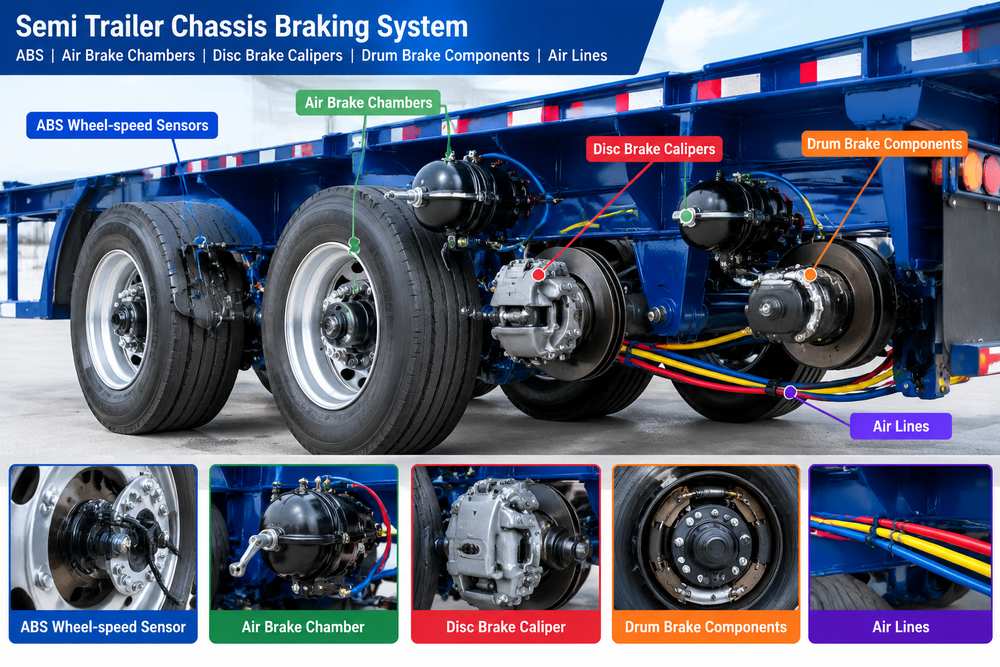
During the quotation and inspection process, verify these items:
- Brake type, component model and compatibility with the selected axles.
- ABS specification, sensor installation, wiring and electrical connectors where applicable.
- Air brake chambers, reservoirs, lines, fittings and visible connections.
- Availability of replacement brake components in the destination market.
- Required approvals, test records and inspection documents.
- Safe functional testing before the trailer enters service.
For routes with steep descents or sustained heavy loading, the complete vehicle’s braking capability and operating practices require particular attention. Trailer brake selection alone cannot prevent overheating under every condition. Proper adjustment, maintenance, suitable driving techniques and compliance with vehicle-weight restrictions remain important.
Specify the brake configuration in the purchase contract and have qualified personnel carry out the appropriate tests. If the trailer is being exported, confirm destination-specific braking and ABS requirements before the production specification is finalized.
WhatsApp Us to Confirm Axles and BrakesWhen Should You Choose a Lightweight Semi Trailer Chassis?
A lightweight semi trailer chassis can increase the payload available within a legal gross-weight limit when the operation is weight-limited and the structural design remains suitable for the application. Potential weight-saving options include optimized high-strength steel sections, aluminium wheels and aluminium body components. Each option must be assessed for cost, durability, compatibility and the actual operating conditions.
The supplied source indicates that selected lightweight components may reduce tare weight by around half a tonne. This is an indicative figure, not a guaranteed saving for every trailer. The actual result depends on the baseline configuration, component choices, body type, axle package and accessories.
| Option | Potential benefit | Points to verify |
|---|---|---|
| Optimized steel chassis | Potential reduction in structural mass through engineering optimization | Material grade, design calculations, weld requirements and fatigue performance. |
| Aluminium wheels | Potential reduction in wheel and overall vehicle mass | Load rating, compatibility, purchase cost and local availability. |
| Aluminium body components | Potential weight reduction for compatible body designs | Impact resistance, repair methods, cargo requirements and lifecycle cost. |
Does a Lower Tare Weight Always Improve Profitability?
No. The commercial benefit depends on the legal payload limit, cargo density, route characteristics, trip frequency and cost of the lightweight configuration. A fleet carrying dense materials may be constrained by axle loads or gross vehicle weight. A fleet transporting lighter, bulky goods may be constrained by volume instead, making additional payload capacity less valuable.
Compare the complete configurations under the same legal operating limits. Ask for the expected tare weight with all selected options included, and clarify whether spare tyres, toolboxes, accessories and other items are counted. Where accurate weight is commercially important, arrange weighing of the completed trailer before shipment.
Never sacrifice structural suitability to achieve an attractive tare-weight figure. A semi trailer chassis must remain appropriate for the intended cargo and duty cycle. Any lightweight redesign should be supported by the manufacturer’s engineering assessment and documented specifications.
How Do You Inspect a Semi Trailer Chassis Before Delivery?
A structured factory inspection allows buyers to compare the finished trailer against the contract and approved drawings before acceptance. It can identify visible defects, missing components and configuration differences while corrective action is still practical. The inspection should cover the frame, running gear, accessories, surface protection and any specified functional tests.
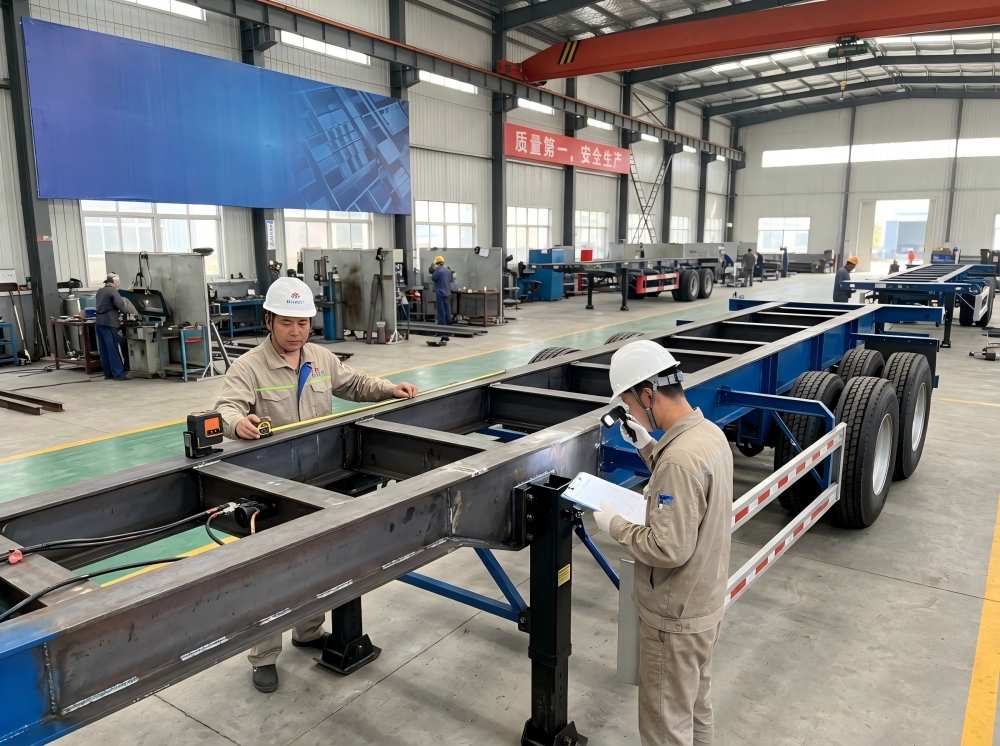
1. Check Main Beam Straightness and Welding
- Inspect the visible main beam surfaces for bending, deformation or physical damage.
- Examine accessible welds for cracks, missed welds, obvious discontinuities and inconsistent finishing.
- Check the gooseneck or other reinforced transition areas against the approved design.
- Count crossmembers and confirm their placement against the contract or drawing.
- Check accessible fasteners and rivets for missing, loose or visibly corroded components.
- Confirm that specified steel grades and plate dimensions are supported by the agreed documentation.
2. Verify Axles and Suspension
- Check axle identification marks and model information against the purchase specification.
- Inspect visible axle housings, hubs and seals for physical damage or signs of leakage.
- Confirm the suspension type and axle arrangement match the approved configuration.
- Check leaf springs for broken leaves, displacement and abnormal wear.
- Inspect air bags, lines and fittings for visible damage or leakage where air suspension is installed.
- Review brake chambers, ABS sensors, cables and connections for completeness and visible damage.
- Verify tyre sizes, load ratings and brands against the contract.
3. Inspect the Deck, Body and Accessories
Check the deck or body panels for obvious deformation, damage, uneven surfaces and poor finishing. Inspect load restraint points, hinges, latches, doors and other moving components for proper operation. Confirm that the tool box, ladder, tarpaulin frame, spare-wheel carrier and other accessories are present where specified.
For a tipper semi trailer, inspect the body structure, hydraulic hoses, fittings, cylinder mounting points and lifting mechanism. Where the contract specifies hydraulic cylinder pressure testing, request the manufacturer’s test procedure and recorded results. Smooth lifting operation alone does not establish that a cylinder has passed a specified pressure test.
4. Carry Out Appropriate Functional Tests
Functional tests should be conducted by qualified personnel under controlled and safe conditions. Where required, connect the trailer to a compatible prime mover and verify the specified brake, lighting and coupling functions. A road test should be carried out only when permitted and safe; it does not replace a complete mechanical or braking inspection.
Record any defects or deviations with photographs, descriptions and references to the contract. Agree on corrective actions and verify their completion before final acceptance or shipment. For safety-critical applications, independent inspection or appropriate non-destructive testing may be necessary.
Recommended pre-delivery records
- Approved chassis drawing and technical configuration sheet.
- Component identification and material documentation where agreed.
- Inspection checklist with dated photographs.
- Applicable functional test or pressure-test records.
- Written list of discrepancies and corrective actions.
- Final acceptance record and agreed shipping documentation.
A visual inspection cannot confirm every hidden defect or establish the performance of every component. Use the inspection scope, technical records and suitable testing procedures specified in the purchase contract.
Discuss Factory Inspection RequirementsHow Can Buyers Compare Semi Trailer Chassis Manufacturers?
The best way to compare chassis manufacturers is to request equivalent technical specifications and evaluate the complete supply scope. A lower quotation may reflect a different steel specification, lighter running gear, fewer accessories or a narrower inspection scope. Unless these differences are identified, the prices are not directly comparable.
| Evaluation item | What the buyer should request |
|---|---|
| Chassis design | Approved drawing, dimensions, material grade and specified plate thicknesses. |
| Running gear | Axle brand, model, rating, suspension configuration and brake specification. |
| Tare weight | Configuration-specific weight with included options and exclusions clearly stated. |
| Manufacturing quality | Inspection scope, applicable test records and agreed acceptance criteria. |
| After-sales service | Warranty conditions, parts availability, technical support and claim procedures. |
| Export arrangements | Delivery scope, Incoterms, documentation responsibilities and shipping schedule. |
Before and After: A More Reliable Procurement Process
Before: Comparing Price Alone
- Steel grades and beam dimensions are not clearly stated.
- Axle brands and ratings differ between quotations.
- Accessories and inspection responsibilities remain unclear.
- Warranty conditions are based on verbal discussions.
- Import requirements are checked after production starts.
After: Comparing Written Specifications
- All suppliers quote against the same technical sheet.
- Critical components and approved alternatives are documented.
- Inspection, accessories and delivery scope are itemized.
- Warranty and corrective-action procedures are agreed in writing.
- Destination requirements are reviewed before manufacturing.
This process helps procurement teams evaluate the real commercial value of a semi trailer chassis. The lowest initial price is not necessarily the lowest ownership cost. Maintenance, downtime, tyre wear, parts supply, payload efficiency and the expected service life can all influence operating economics.
For international orders, define the payment terms, delivery responsibilities, inspection milestones, warranty provisions and required documentation in the contract. Confirm the destination country’s vehicle, customs and import requirements with the relevant authorities or a qualified customs broker.
What Should Export Buyers Confirm Before Shipment?
Export buyers should finalize the semi trailer chassis configuration and documentation requirements before production is completed. The chassis must be compatible with the prime mover and intended application, while the finished trailer must meet applicable destination-market requirements. Early verification reduces the likelihood of late changes, missing documents or avoidable shipping delays.
Prime Mover and Kingpin Compatibility
Provide the tractor model and relevant coupling specifications. Confirm the fifth-wheel height, kingpin dimensions, coupling compatibility, electrical connectors and air-brake connections. The tractor’s permitted axle loads and the intended cargo distribution must also be considered when assessing the complete vehicle combination.
Dimensions, Payload and Local Regulations
Confirm overall length, width, height, axle spacing, ground clearance and other relevant dimensions. Provide cargo dimensions and the expected loading pattern so the supplier can assess the intended application. Verify the destination’s axle-load limits, gross vehicle weight rules, braking requirements, lighting regulations and registration conditions before placing the order.
Export Documents and Shipping Arrangements
Agree on the documents required for the transaction, which may include a commercial invoice, packing list and transport document, together with technical or conformity records where applicable. Requirements vary by destination, product classification and transaction structure, so the buyer should confirm the exact document list with the importer or customs broker.
Shipping arrangements should reflect the finished trailer’s actual dimensions, weight, loading method and lashing requirements. Confirm the carrier’s acceptance conditions and whether the selected transport method is suitable for the trailer configuration. Do not assume that all semi trailers can be shipped under the same arrangements.
ZW Group encourages buyers to provide their destination market, technical specifications and inspection requirements when requesting a quotation. This gives both sides a clearer basis for confirming the configuration, commercial scope and delivery arrangements.
Frequently Asked Questions About Semi Trailer Chassis
What is the most important part of a semi trailer chassis?
The main beams are central structural components because they carry bending loads and transfer forces through the chassis. However, overall performance also depends on the crossmembers, kingpin area, suspension mounting points, welds, axles and complete vehicle design.
What steel thickness should a semi trailer chassis use?
The supplied source lists an 8 mm upper flange, a 10 mm lower flange and a 6 mm web plate as a reference configuration. These dimensions are not universal requirements. The appropriate thickness depends on the steel grade, beam geometry, loading assumptions and engineering design. Request the approved specification for your trailer.
Is high-strength steel better than ordinary Q235 steel?
High-strength steel can provide higher specified strength properties and may support an optimized structural design. The actual benefit depends on the precise grade, fabrication process and chassis engineering. Confirm the material designation and relevant documentation before comparing steel specifications.
How do I select a heavy-duty semi trailer chassis?
Start with cargo type, payload, load distribution, route conditions, prime mover specifications and local legal limits. Then evaluate the main beam design, axle ratings, suspension, braking system and tare weight as a complete configuration. Heavy-duty use should be supported by a suitable engineering specification.
Are FUWA and BPW axles suitable for export trailers?
They are established axle brands identified in the supplied source material. Suitability depends on the exact model, rating, trailer configuration, destination requirements and local parts availability. Confirm the specified product and its documentation rather than relying on the brand name alone.
Should I choose leaf-spring or air suspension?
Leaf-spring suspension may suit operations that prioritize straightforward mechanical servicing and robust construction. Air suspension may be appropriate where ride characteristics and vibration management are important. The choice should reflect the duty cycle, maintenance capability and full operating cost.
How can I reduce semi trailer chassis maintenance costs?
Specify components suited to the operating conditions, confirm replacement-part availability, inspect the chassis and running gear before delivery, and follow an appropriate maintenance schedule. Correct loading, tyre maintenance, suspension checks and timely repair can help reduce avoidable downtime.
Can a lightweight chassis carry more cargo?
A lower tare weight can increase available payload when the vehicle is limited by legal gross weight and the chassis remains suitable for the application. The actual benefit depends on the configuration, cargo, axle loads and local regulations. Request the finished trailer’s specified tare weight and verify the delivered unit when required.
What should I inspect before accepting a semi trailer chassis?
Inspect the main beams, accessible welds, crossmembers, reinforcement, axle identification, suspension, brakes, tyres, body accessories and specified test records. Compare the finished trailer against the approved drawing and contract. Record defects and confirm corrective actions before acceptance.
What information should I send to a semi trailer chassis manufacturer?
Provide the trailer type, cargo, target payload, destination country, prime mover model, route conditions, required dimensions, axle and suspension preferences, braking requirements, quantity and delivery schedule. Any available drawings or local compliance requirements will also help establish the correct specification.
How can I avoid receiving a different chassis configuration from the one ordered?
Record the steel grade, plate dimensions, chassis drawing, axle brand and rating, suspension, braking system, tyres, accessories, inspection requirements and approved alternatives in the purchase contract. Review the finished trailer against these documents before shipment.
Need a Semi Trailer Chassis Configuration for Your Market?
Choose your chassis based on the actual transport task, not just the purchase price. ZW Group works with international commercial vehicle buyers evaluating chassis structure, steel specifications, axle assemblies, suspension, braking systems and export requirements.
Send us your cargo type, target payload, destination country, prime mover details and preferred configuration. Our team can review your requirements and prepare a quotation based on the agreed technical scope.
For bulk orders, dealer inquiries and project procurement, include your required quantity, delivery schedule and inspection conditions. Confirming the specification in writing helps establish a clear basis for manufacturing, acceptance and shipment.
Contact ZW Group