Semi Trailer Structure and Types: How to Choose the Right Trailer | ZW Group

A suitable semi trailer must match the cargo, prime mover, road conditions, loading method and legal limits of the destination market. For fleet operators, distributors and commercial vehicle buyers, understanding the main structural assemblies is the most reliable starting point for selecting a trailer that can perform its intended transport task without unnecessary maintenance or operating costs. The chassis carries and transfers loads, the cargo structure supports or contains the goods, the axle and suspension assemblies manage running loads, and the kingpin, landing gear, braking system and electrical equipment support safe operation. Specialized equipment, including hydraulic tipping systems, tank valves and container twist locks, determines how particular trailers handle their loads.

This guide explains how a semi trailer is constructed, what each major component does, how common configurations differ and which technical details buyers should confirm before placing an export order. The objective is practical: help procurement teams specify the right vehicle, compare quotations on a consistent basis and reduce the risk of purchasing equipment that does not suit local operating conditions.

Need a semi trailer configuration for your market?

Send ZW Group your cargo description, required dimensions, prime mover specifications and destination country. These details help establish a practical starting point for configuration discussions.

Discuss Your Requirements on WhatsApp

1. What Are the Main Structural Components of a Semi Trailer?

A semi trailer is an articulated commercial vehicle designed to carry part of its total operating load through its own running gear while transferring a portion of the load through the fifth-wheel connection to the towing tractor. Its precise load distribution depends on the cargo position, chassis geometry, axle arrangement and coupling location. The principal assemblies are the chassis frame, cargo-carrying structure, running gear, coupling and parking equipment, braking and electrical systems, and any specialized operating mechanisms.
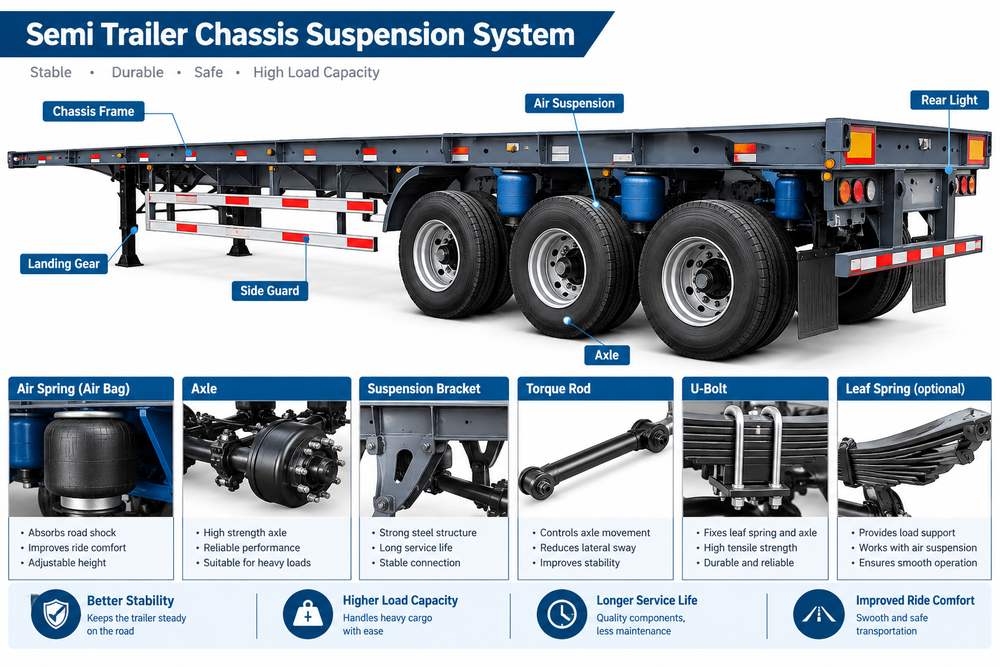
Semi trailer structure showing the chassis frame, cargo deck, axle group, suspension, kingpin, landing gear and braking components

1.1 How Does the Semi Trailer Chassis Carry Loads?

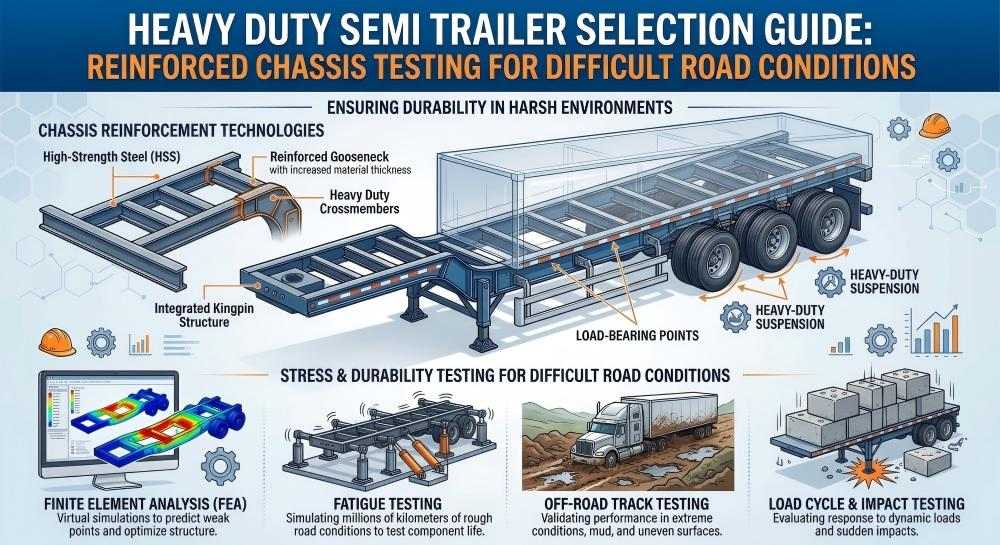
The chassis frame is the primary load-bearing structure. It normally consists of longitudinal main beams, crossmembers, connecting plates, mounting brackets and other reinforcing elements. Together, these components resist bending and torsional loads and transfer forces toward the axle group and the tractor coupling point.

When evaluating a semi trailer chassis, buyers should examine the complete structural design rather than judge capacity by the apparent thickness of the main beams. Beam section geometry, steel grade, plate thickness, reinforcement arrangement, weld quality, load distribution and manufacturing consistency all influence structural performance. A heavier frame is not automatically a better investment if its additional mass reduces payload without providing a justified operational benefit.

High-tensile steel may be suitable for particular frame designs, but a steel grade alone does not establish the permissible payload or fatigue life of the complete vehicle. The relevant material specification, design calculations, manufacturing procedures and applicable inspection requirements must correspond to the intended duty.

1.2 What Determines the Cargo Structure?

The cargo-carrying assembly is the part that directly supports, contains or secures the goods. Depending on the application, it can be an open flatbed, a side-wall body, a box body, a container-carrying frame, a tipping body, a tank or a low-height equipment platform.

Its design determines loading access, cargo protection, usable dimensions, restraint options and unloading arrangements. A flatbed provides open access from several directions, while an enclosed body protects goods from weather exposure. A dump body incorporates a tipping mechanism, and a tanker requires a vessel and associated equipment suitable for its specified medium. Selecting the correct cargo structure is therefore a functional decision, not simply a matter of appearance.

1.3 How Do Axles and Suspension Affect Operation?

The running gear generally includes axles, suspension, wheels, tires and associated mounting hardware. These components support the trailer’s share of the load, influence tire contact with the road and affect vibration, handling and maintenance requirements.

Leaf-spring suspension is commonly considered for applications where mechanical simplicity and straightforward servicing are priorities. Air suspension may be appropriate where ride characteristics, cargo sensitivity or other operating requirements justify it. The correct choice depends on the actual route, load profile, maintenance resources, cost and destination-market requirements.

Adding axles does not automatically authorize a higher payload. Individual axle limits, axle spacing, gross combination mass, road restrictions and registration requirements remain relevant. A buyer should confirm the permitted operating weights before specifying the axle group.

1.4 Why Are the Kingpin and Landing Gear Important?

The kingpin connects the semi trailer to the tractor’s fifth wheel. The kingpin specification, mounting structure and fifth-wheel configuration must be compatible in dimensions, rated capacity and operating condition. Inspection should include abnormal wear, cracks, deformation, loose fasteners and correct locking engagement.

Landing gear supports the uncoupled trailer and provides clearance for coupling and uncoupling operations. Its capacity, mounting arrangement, operating mechanism and ground clearance should suit the loaded or unloaded support condition specified by the manufacturer. Incorrect operation or inadequate ground support can create serious stability risks during parking and loading.

1.5 Which Systems Support Safe and Specialized Operation?

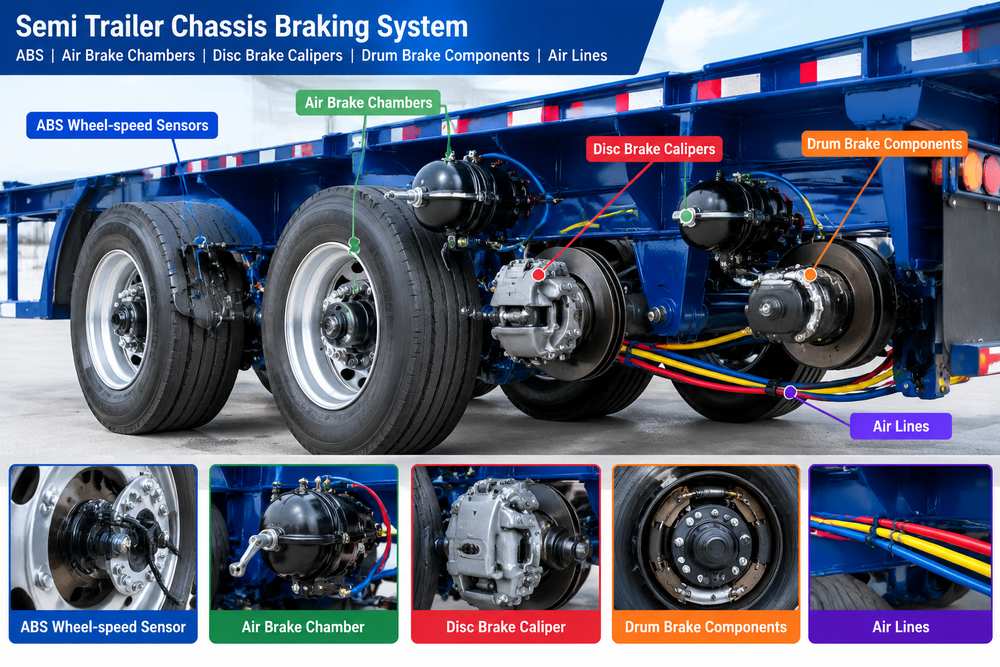
The braking system provides the required braking function for the articulated vehicle combination. Depending on the design and destination requirements, equipment may include air brake chambers, service and parking brake components, ABS wheel-speed sensors and associated control equipment. Lighting and electrical systems provide road signals, illumination and power for compatible accessories.

Specialized semi trailer configurations may also use hydraulic cylinders, pumps, hoses, valves, container twist locks, tank valves, discharge pipelines, tarpaulin mechanisms or removable loading ramps. These features add functional capability, but they also introduce inspection, maintenance, training and spare-parts requirements. Buyers should confirm the actual supply scope and connection interfaces rather than assume that every accessory is included in the base quotation.

AssemblyPrimary functionWhat buyers should verify
Chassis frameCarries and transfers structural loadsDesign, material specification, reinforcement and manufacturing quality
Cargo structureSupports, contains or protects goodsDimensions, loading access, restraint points and cargo compatibility
Axles and suspensionSupport running loads and manage road contactAxle ratings, spacing, suspension type and serviceability
Kingpin and landing gearConnect to the tractor and support uncoupled operationFifth-wheel compatibility, rated capacity and operating condition
Brakes and electrical equipmentProvide braking, signaling and lighting functionsSystem compatibility, applicable regulations and replacement parts

2. Which Semi Trailer Types Are Suitable for Different Cargo?

The best semi trailer type is the one that accommodates the physical characteristics of the cargo and the actual loading and delivery process. Buyers should start with cargo dimensions, weight, density, packaging, loading equipment, unloading location and route restrictions. Industry labels alone do not establish whether a particular configuration will work.
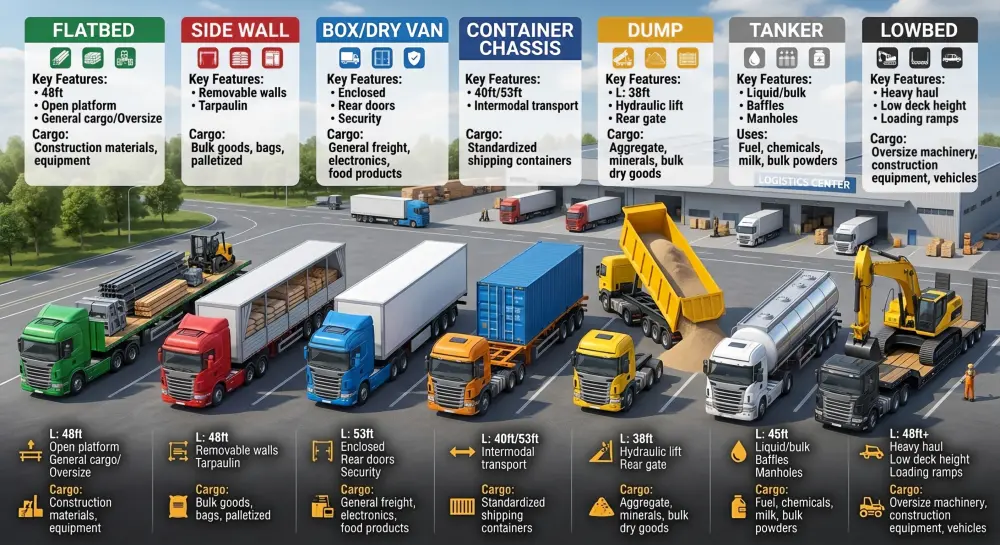
Comparison of flatbed, side wall, box, container chassis, dump, tanker and lowbed semi trailer types for commercial cargo transport

2.1 When Should You Choose a Flatbed Semi Trailer?

A flatbed semi trailer is suitable for cargo that can be supported on an open deck and secured with an appropriate restraint system. Typical examples include steel products, timber, palletized goods, building materials and some industrial equipment.

Its open design can simplify top loading, side loading and access by cranes or forklifts, subject to the site layout and equipment used. However, the absence of fixed side walls means cargo restraint must be planned carefully. Buyers should assess deck dimensions, floor construction, lashing points, load distribution and the intended method of securing each cargo category.

Long steel products and machinery may require different restraint arrangements even when their total weights are similar. The deck must support the actual contact loads, while tie-down equipment must be appropriate for the cargo geometry and applicable securement rules.

2.2 How Does a Side Wall or Stake Semi Trailer Improve Cargo Handling?

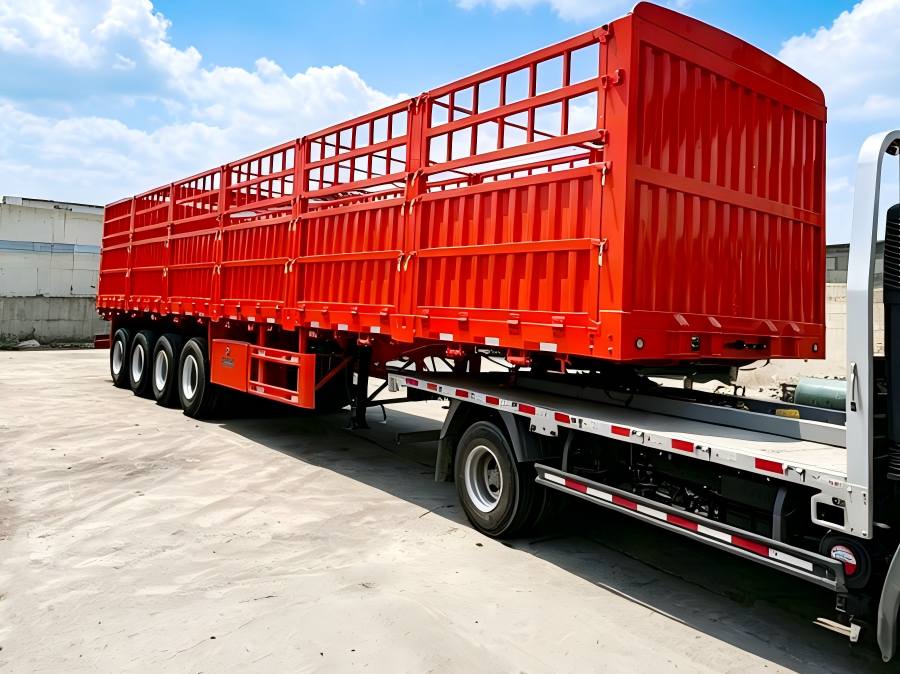
A side wall or stake semi trailer is designed for general cargo that benefits from lateral boundaries or a particular containment arrangement while retaining flexible loading access. Depending on the construction, it may suit bagged goods, palletized products, agricultural supplies, building materials and mixed commercial freight.

The height and configuration of the side walls or stakes should correspond to the cargo dimensions and the intended loading method. Removable or adjustable elements may provide operational flexibility where the design permits them, but buyers should verify the actual construction instead of assuming that every side wall trailer has interchangeable panels.

Side walls are not a substitute for proper load restraint. The buyer must establish whether the structure is intended to contain the cargo, support a particular loading arrangement or provide additional protection. Loose goods may require packaging, covers or other measures to prevent loss during transport.

2.3 What Should You Check Before Buying a Box Semi Trailer?

A box semi trailer is appropriate for cargo that needs an enclosed transport space, such as goods requiring protection from rain, road dust or uncontrolled external access. It may be used for packaged products, consumer goods, cartons and other freight suited to the available internal dimensions.

The decisive measurements are usable internal length, width and height, door opening dimensions, floor load capacity and the clearance needed for pallets or handling equipment. Nominal exterior dimensions do not tell the buyer how much cargo can actually be loaded.

For forklift loading, check the floor design, door access, turning space and loading dock arrangement. For goods that need segregation, confirm the available internal configuration and cargo restraint points. Enclosure alone does not guarantee a particular level of temperature control, waterproofing or security; any such requirement must be specified and verified separately.

2.4 How Do You Select a Container Chassis Semi Trailer?

A container chassis semi trailer transports containers through dedicated mounting points and locking devices. It is suitable for containerized freight moving between ports, terminals, warehouses, distribution centers and inland destinations.

Before purchasing, confirm the container sizes and configurations to be carried, the position and compatibility of the twist locks, axle arrangement, tractor coupling and route-specific height and weight restrictions. Do not assume that a chassis configured for one container arrangement will accommodate every container length or loading combination.

Operational compatibility also depends on terminal handling procedures, container lifting equipment, road access and the permitted gross weights of the vehicle combination. For fleet operators, standardizing container configurations across the fleet may simplify dispatching and maintenance, provided that the routes and cargo requirements support that decision.

2.5 When Is a Dump Semi Trailer the Right Choice?

A dump semi trailer is designed to discharge suitable bulk material by raising its body or cargo container with a tipping mechanism. Common applications include sand, gravel, soil, aggregate and other materials whose physical properties allow controlled discharge.

Body volume should be selected in relation to material density and legal payload, not volume alone. A large body filled with dense aggregate may reach the permitted weight before reaching its geometric capacity. A lower-density material may fill the same body without reaching the same mass, subject to its moisture content and handling characteristics.

The hydraulic system, cylinder arrangement, body structure, hinge points and operating controls must be appropriate for the intended material and duty. Unloading conditions matter just as much as the trailer itself: soft ground, cross slopes, overhead obstructions and uneven material distribution can increase tipping risks. The operator must follow the manufacturer’s procedures and use a suitable unloading surface.
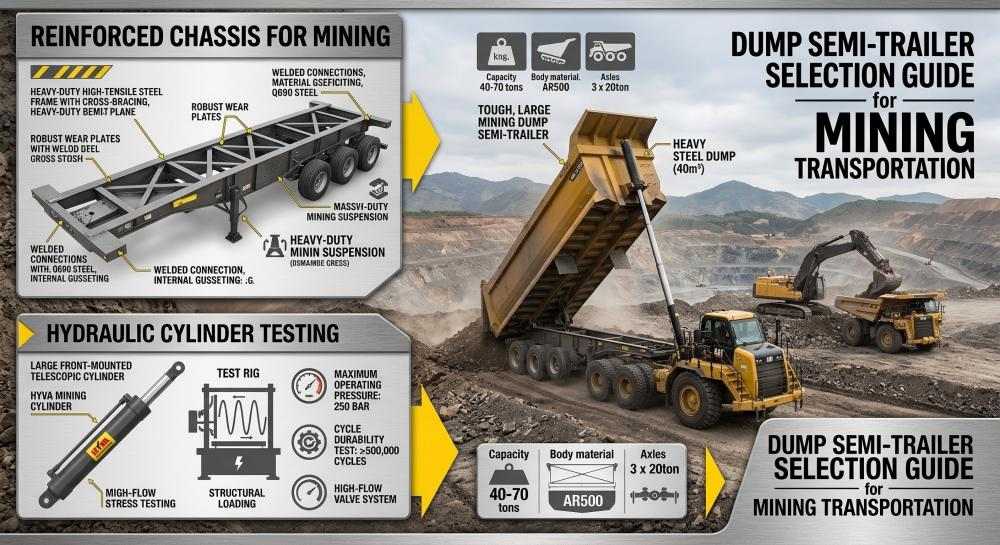
Dump semi trailer with tipping body, hydraulic lifting cylinder, chassis frame, axle group and rear discharge structure for bulk material transport
Hydraulic lifting equipment must be matched to the body design, load characteristics and safe unloading procedure.

Specify the tipping system before comparing quotations.

Confirm the intended material, target body volume, expected operating loads, hydraulic interfaces and service arrangements. The correct configuration depends on the complete operating system rather than the cylinder alone.

Ask About Dump Semi Trailer Specifications

2.6 What Makes a Tanker Semi Trailer Different?

A tanker semi trailer carries liquids, powders or other specified materials in a vessel designed for the intended medium and operating conditions. The correct configuration depends on the cargo’s chemical properties, density, temperature requirements, cleaning procedures, discharge method and applicable transport regulations.

Tank material, internal arrangement, valves, pipelines, access equipment and discharge interfaces must be considered as a system. Compatibility cannot be established simply because two tankers have similar external shapes. A vessel suitable for one liquid may be unsuitable for another because of material compatibility, pressure requirements, contamination risks or regulatory restrictions.

For powder tankers, buyers should pay particular attention to the intended bulk material, pneumatic discharge arrangement, air supply requirements and receiving-site connections. For liquid tankers, verify the loading and unloading interfaces, cleaning requirements and any specific safety equipment required by the cargo.

Never assume that a general-purpose tanker is approved for hazardous materials or that its design automatically meets the regulations of the importing country. The exact cargo, design specification and legal requirements must be confirmed before manufacture or shipment.

2.7 Why Choose a Lowbed or Lowboy Semi Trailer for Heavy Equipment?

A lowbed semi trailer is designed to transport machinery and equipment whose weight, dimensions or center of gravity make an ordinary flatbed unsuitable. Typical cargo includes excavators, bulldozers, loaders, road construction machinery and other heavy equipment, subject to the trailer’s design and applicable transport rules.

Platform height is an important selection factor because a lower loading height may reduce overall transport height. However, platform height must be evaluated alongside deck length, width, structural capacity, axle loading, loading ramps, tractor compatibility and route clearance.

Equipment weight alone is insufficient for specifying a lowbed. The buyer should provide the machine’s transport dimensions, operating or transport weight, track or wheel configuration, ground clearance and loading requirements. The machine’s center of gravity and position on the deck affect load distribution and stability.

Where a detachable gooseneck or removable loading arrangement is required, confirm the specific coupling mechanism, loading procedure, ramp arrangement and tractor compatibility. Oversize or overweight movements may require permits, escorts or route assessments. Trailer selection does not remove those obligations.

2.8 How Should You Evaluate Curtain-Side and Other Specialized Trailers?

Curtain-side and other specialized semi trailers serve transport operations that depend on particular access arrangements or cargo-handling methods. Curtain-side bodies can provide practical side access for compatible palletized freight, while other specialized designs may incorporate removable structures, dedicated loading equipment or cargo-specific restraints.

The main question is whether the body and access system fit the real loading workflow. Buyers should examine forklift access, available working space, cargo protection, floor loading requirements, restraint arrangements and the maintenance capability available at operating locations.

Specialized equipment is valuable when it removes a genuine handling constraint. If the operation rarely uses the feature, its added cost, weight, inspection needs and potential downtime should be considered before it becomes part of the specification.

3. How Can You Compare Semi Trailer Types Before Purchasing?

A consistent comparison should use the same cargo, operating route, loading process and legal constraints for every candidate. The following table provides a starting point for shortlisting the appropriate semi trailer configuration.

Trailer typeTypical applicationKey specification checksMain limitation to consider
FlatbedSteel, timber, machinery and palletized freightDeck size, floor loading, tie-down pointsRequires suitable cargo protection and restraint
Side wall or stakeGeneral cargo and goods needing lateral containmentWall height, cargo dimensions, loading accessWall configuration may not suit every load
BoxPackaged goods requiring enclosureInternal dimensions, doors, floor capacityAccess and cargo dimensions are constrained
Container chassisIntermodal container transportContainer compatibility, twist locks, route limitsLimited to compatible container arrangements
DumpSuitable bulk materials and earthworksBody volume, payload, hydraulics, unloading conditionsTipping requires a suitable operating surface
TankerSpecified liquids, powders or other compatible mediaMedium compatibility, vessel design, valves, regulationsCargo-specific design and cleaning requirements
LowbedHeavy machinery and oversized equipmentDeck height, axle loading, ramps, route clearanceMay require permits and specialized route planning
Curtain-sideCompatible palletized and general freightSide access, curtain system, floor and restraint designCargo protection depends on the actual body design

The table is intended to identify the most relevant questions, not to establish universal payload figures. Rated capacity, dimensions, equipment and legal operating limits vary by configuration and destination. A technically sound quotation should identify the proposed specification clearly enough for the buyer to compare it with alternative offers.

4. How Do Cargo Density, Payload and Body Volume Affect Trailer Selection?

Payload planning must consider both the physical volume of the cargo and its mass. For bulk materials, the basic relationship is that cargo mass equals material density multiplied by occupied volume. If the cargo is relatively dense, the legal payload may be reached before the body is full. If the cargo is less dense, the available body volume may become the limiting factor first.

For example, a buyer comparing dump bodies should not choose the largest available volume without identifying the expected material. Sand, gravel, soil and other bulk products can differ substantially in density and moisture content. Actual loading patterns can also leave unused space or create uneven weight distribution.

For palletized or packaged goods, the decisive factor may instead be floor space, stack height, door dimensions or the permitted distribution of weight across the deck. For heavy machinery, concentrated contact loads and center-of-gravity position can matter more than the nominal platform area.

Before approving a cargo capacity specification, confirm:

  • Expected cargo mass and physical dimensions.
  • Material density, moisture variation and loading pattern, where applicable.
  • Permitted payload and gross combination mass on the intended route.
  • Axle loads, axle spacing and the distribution of load between the tractor and trailer.
  • Deck, floor or body capacity for the actual contact and loading conditions.
  • Space required for securing, handling and unloading the cargo.

These checks help avoid a common purchasing mistake: comparing semi trailer quotations by body volume or advertised capacity while overlooking the constraints that determine usable payload in service.

5. Why Must the Semi Trailer Match the Prime Mover?

A semi trailer and its tractor must operate as a compatible vehicle combination. Matching the kingpin and fifth wheel is only one part of the process. The tractor’s permitted towing capacity, axle ratings, coupling height, braking interfaces, electrical connections and operating configuration must also be suitable for the intended trailer and cargo.

A prime mover with sufficient engine power may still be unsuitable if its permitted combination mass, fifth-wheel rating or axle loading does not support the proposed application. Similarly, a trailer with an appropriate nominal payload may exceed road or registration limits when coupled to a particular tractor and loaded in a particular way.
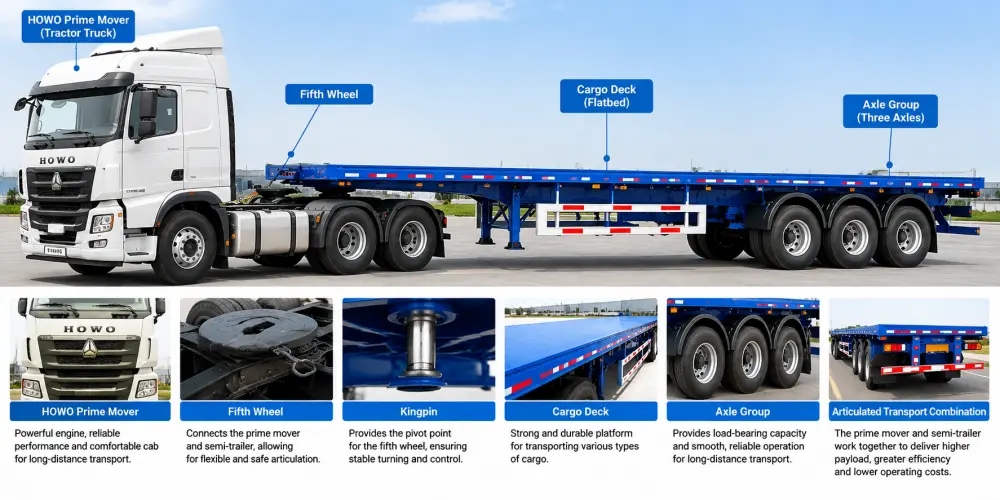
Semi trailer kingpin engaging a compatible prime mover fifth wheel with chassis connection and landing gear arrangement

Before finalizing the order, provide the supplier with the prime mover make and model, relevant coupling specifications, intended cargo weight, expected route and any applicable local limits. Where the fleet operates several tractor models, the buyer should identify whether the trailer must be compatible with all of them or with a designated tractor configuration.

Braking and electrical compatibility also require attention. Confirm the required connection standards, control equipment, lighting arrangement and any additional systems mandated by the importing market. The exact requirements should be established from the tractor and trailer technical documentation and applicable regulations.

6. How Should Buyers Specify a Semi Trailer for Export?

A complete export specification reduces the risk of receiving a vehicle that meets the general product description but does not match the buyer’s operating requirements. Procurement teams should prepare a written requirement sheet before requesting final quotations, especially when several suppliers offer different standard configurations.

Step 1: Define the Cargo and Transport Task

Identify the material or goods, typical load dimensions, maximum intended cargo mass, loading equipment, unloading method and route conditions. If the fleet carries different cargo categories, explain which loads are routine and which are occasional. A multi-purpose requirement may call for a different design from a dedicated single-cargo operation.

Step 2: Confirm Dimensions and Legal Requirements

Specify required overall dimensions, useful deck or body dimensions, target platform height and relevant clearance restrictions. Confirm the applicable axle-load, gross-weight, width, height and length limits for the destination market and planned routes. Where special permits or technical approvals may be required, establish the applicable process before finalizing the configuration.

Step 3: Identify Major Components and Interfaces

Document the intended axle arrangement, suspension type, braking configuration, kingpin and fifth-wheel compatibility, landing gear and tire requirements. For specialized trailers, add the exact hydraulic, pneumatic, electrical or cargo-handling interfaces required for the operating system.

Step 4: Confirm Manufacturing and Inspection Scope

Ask the supplier to identify the agreed materials, component specifications, drawings and inspection records that apply to the order. Clarify what documentation will be supplied, which checks will be performed, how deviations are handled and which acceptance criteria govern delivery. Do not treat general promotional statements as substitutes for an agreed inspection scope.

Step 5: Verify Shipping and Import Arrangements

Confirm the shipment configuration, dimensions and weight information needed for freight planning, as well as the commercial documents and import requirements applicable to the destination. Depending on the shipment, relevant documents may include the commercial invoice, packing list, transport document, certificate of origin or technical documents required by the importing authority. The actual requirements vary by destination, product classification and transaction terms.

Agree on delivery terms, payment milestones, lead-time assumptions, spare-parts arrangements and responsibilities for export and import formalities. If the semi trailer requires local registration or approval, establish which documents the supplier can provide and which actions remain the responsibility of the importer.

Semi Trailer RFQ Checklist

Use the following list when preparing a request for quotation.

  • Destination country and intended operating region.
  • Trailer type and cargo description.
  • Required dimensions, payload target and legal weight limits.
  • Prime mover details and fifth-wheel specifications.
  • Axle, suspension, braking and tire requirements.
  • Body material, structural features and cargo restraint needs.
  • Specialized equipment and required operating interfaces.
  • Inspection criteria, documentation and acceptance requirements.
  • Delivery terms, spare parts and after-sales support expectations.
Send Your Semi Trailer RFQ on WhatsApp

7. What Should You Inspect Before Accepting a Semi Trailer?

Acceptance inspection should be based on the agreed specification and documented criteria rather than a general visual impression. A semi trailer can appear well finished while still having a mismatch in its interfaces, equipment scope or technical documentation. Inspection should therefore cover both the physical vehicle and the records needed to confirm what was supplied.

Structural and Dimensional Checks

  • Compare the completed chassis and cargo structure with the approved drawings and purchase specification.
  • Inspect accessible welds, joints, mounting points and structural members for visible defects or unexplained deviations.
  • Verify the dimensions and mounting positions that determine loading, coupling and compatibility with the intended operation.
  • Confirm that the deck, body, tank or container interfaces match the agreed configuration.

Running Gear, Coupling and Braking Checks

  • Confirm the specified axle and suspension assemblies and inspect their mounting condition.
  • Check the kingpin specification, accessible mounting areas, landing gear and fifth-wheel compatibility requirements.
  • Verify the agreed brake components, air-line connections, electrical connectors and lighting equipment.
  • Review the applicable inspection or functional-test records required by the purchase agreement.

Specialized System Checks

For a dump semi trailer, confirm that the hydraulic equipment and operating interfaces correspond to the approved specification. Any cylinder or hydraulic test should be assessed against the defined test procedure, operating conditions and acceptance criteria. A generic claim that a cylinder was tested does not establish that the complete system satisfies every possible operating requirement.

For a tanker, verify the vessel and associated equipment against the specified medium and applicable documentation. For a lowbed, check the loading arrangement, ramps or detachable components as applicable. For a container chassis, verify the specified locking devices and their positions. Every specialized feature should be inspected according to its actual function.

Documentation and Handover

Match the vehicle identification and supplied documents to the purchase order. Record any agreed deviations and outstanding items before acceptance. Where the contract requires operating instructions, maintenance information, component lists or test records, confirm that these have been provided in the agreed format.

A structured acceptance process gives the buyer a clear record of the delivered configuration. It also creates a useful baseline for maintenance, warranty communication and future spare-parts procurement.

8. How Can the Right Semi Trailer Reduce Total Operating Costs?

The economic value of a semi trailer depends on its suitability for the actual transport cycle, not just its purchase price. A lower initial quotation may be less attractive if the configuration creates loading delays, limits useful payload, requires difficult-to-source components or fails to match the fleet’s operating routes.

Buyers should compare total operating cost using a consistent set of assumptions. Relevant factors include acquisition cost, fuel-related effects of the complete vehicle combination, payload utilization, tire consumption, scheduled maintenance, unscheduled repairs, downtime, loading efficiency and expected service life. These factors should be evaluated against the same cargo task and working conditions; otherwise, a cost comparison can produce a misleading result.

Decision areaShort-term considerationLong-term operating implication
Chassis designPurchase price and tare weightPayload utilization, structural suitability and maintenance exposure
Axle and suspensionInitial equipment cost and specificationServiceability, tire wear and compatibility with operating routes
Cargo structureBody price and usable dimensionsLoading speed, cargo protection and practical capacity
Specialized systemsEquipment cost and installation requirementsMaintenance, spare-parts availability and downtime risk
Export arrangementsFreight, documents and import proceduresDelivery predictability, registration readiness and support costs

For a fleet with frequent, repetitive loads, a dedicated configuration may improve utilization and simplify operating procedures. For a fleet handling varied cargo, a more flexible structure may be justified if it can safely accommodate the intended load types. The correct choice depends on the frequency of each transport task, the cost of changing equipment and the operational penalties associated with unused capacity.

Spare-parts planning also deserves attention. Confirm the identification of critical components, maintenance requirements and realistic supply arrangements before ordering. This is particularly important when vehicles will operate far from major service centers or in locations where specialized hydraulic, braking or suspension components are not readily available.

9. Why Work with ZW Group on Your Semi Trailer Requirements?

ZW Group provides a point of contact for buyers evaluating commercial trailer configurations for export applications. The most productive starting point is a clear technical brief: what the trailer must carry, where it will operate, which prime mover will tow it and what the destination market requires.

Rather than comparing suppliers solely on a product name or a headline payload figure, procurement teams should request a defined specification that identifies the proposed structure, running gear, coupling arrangement, braking equipment and specialized functions. Any claim concerning material grades, component brands, certifications, manufacturing capacity or inspection results should be checked against the documents applicable to the actual order.

For distributors and fleet operators, it is also useful to discuss the planned fleet mix, maintenance resources and future spare-parts needs. A configuration that fits the intended operating model can make procurement, driver training, maintenance planning and repeat ordering more consistent.

Request a Semi Trailer Configuration Review

Tell us your cargo type, destination country, target dimensions and tractor details. Include any required axle arrangement, body design, hydraulic equipment or container interface so the discussion can focus on the specifications that affect your purchase.

For the most useful initial review, share your existing technical specification or a reference configuration if available.

Contact ZW Group on WhatsApp: +8615689291106

10. Frequently Asked Questions About Semi Trailer Structure and Selection

What are the main components of a semi trailer?

The main components are the chassis frame, cargo-carrying structure, axles, suspension, wheels and tires, kingpin, landing gear, braking system and electrical equipment. Depending on the trailer type, additional components may include a hydraulic tipping system, tank valves, discharge pipelines, container twist locks or specialized loading equipment.

Which semi trailer type is best for general cargo?

The answer depends on the cargo and loading method. A flatbed suits cargo that can be supported and secured on an open deck. A side wall trailer adds lateral boundaries for compatible loads, while a box trailer provides an enclosed transport space. Curtain-side and other specialized designs may be preferable when side access or a particular handling process is important.

Does a thicker chassis always mean a stronger semi trailer?

No. Chassis performance depends on the complete structural design, material properties, section geometry, reinforcement, weld quality, load distribution and manufacturing consistency. Plate thickness is one factor, not a standalone measure of load capacity or fatigue life.

Does adding more axles increase the legal payload?

Not automatically. The permitted load depends on the relevant axle ratings, axle spacing, gross combination mass, road restrictions and destination-market regulations. Buyers should confirm the applicable limits for the complete vehicle combination before specifying the axle group.

How do I select the right dump semi trailer body volume?

Start with the intended bulk material, its density and moisture variation, the target cargo mass and the legal payload. Then evaluate body dimensions, the hydraulic lifting arrangement, unloading conditions and the permitted weight distribution. Body volume alone does not establish the amount of material that can be legally or safely carried.

What information is needed to purchase a lowbed semi trailer?

Provide the equipment’s transport weight, length, width, height, ground clearance, track or wheel arrangement and center-of-gravity information where available. Also identify the prime mover, required platform dimensions, loading method, axle-load restrictions and route clearance requirements. These details help determine the suitable lowbed configuration and whether special transport approvals may be necessary.

What should I confirm before importing a semi trailer?

Confirm the technical specification, vehicle identification and required documentation, destination-market approval or registration requirements, shipment arrangements, delivery terms and inspection criteria. Requirements vary by country and vehicle configuration, so the importer should establish the applicable rules before shipment.

Can one semi trailer carry several types of cargo?

Some configurations can handle multiple cargo categories, provided that each load is compatible with the deck or body, permitted payload, restraint arrangements and legal requirements. A flexible trailer is not automatically suitable for every type of freight. Tankers, dump bodies and other specialized configurations must be used within their intended design and operating conditions.

How can I check whether a semi trailer matches my tractor?

Check the kingpin and fifth-wheel specifications, tractor and trailer ratings, coupling height, axle loading, braking interfaces, electrical connections and permitted gross combination mass. Use the relevant technical documentation and destination-market requirements rather than relying only on the tractor model name.

What information should I send to ZW Group for a quotation?

Send the destination country, trailer type, cargo description, required dimensions, target payload, prime mover specifications and preferred component configuration. Add special equipment, inspection requirements, shipping expectations and any existing drawings or reference specifications. These details help establish a more precise basis for quotation and technical discussion.

Make Your Next Semi Trailer Purchase Specification-Led

The right semi trailer starts with the cargo and operating task, then moves through chassis design, body configuration, axle and suspension selection, tractor compatibility, safety equipment and destination-market requirements. Buyers who define these factors before requesting quotations can compare suppliers more accurately and reduce the risk of paying for unsuitable equipment or discovering critical incompatibilities after delivery.

Prepare your cargo details and technical requirements, then contact ZW Group to discuss a suitable export configuration.
WhatsApp ZW Group: +8615689291106

Semi Trailer Chassis Guide: Steel, Axles, Suspension & Inspection
Semi Trailer Chassis Guide: Steel, Axles, Suspension & Inspection | ZW Group

ZW Group | Semi Trailer Chassis Manufacturer

How to Choose a Semi Trailer Chassis: A Technical Guide to Strength, Payload and Service Life

A reliable semi trailer chassis starts with the right structural design, verified steel specifications, correctly rated axles and a running gear configuration suited to the actual transport conditions. For fleet operators, trailer dealers, importers and project contractors, these decisions directly affect payload capacity, maintenance requirements, vehicle availability and long-term operating costs.

When comparing manufacturers, do not judge a semi trailer chassis by appearance, overall weight or quotation price alone. Examine the main beam construction, flange and web plate dimensions, gooseneck reinforcement, crossmembers, axle assembly, suspension, braking system and manufacturing quality. The complete structure must work as an integrated system under the intended loading conditions.

ZW Group helps international commercial vehicle buyers evaluate semi trailer configurations for freight transport, construction materials, mining operations, container logistics and heavy-duty applications. This guide explains what to specify, what to inspect and which questions to settle before placing an export order.

WhatsApp ZW Group for Chassis Specifications

What Is a Semi Trailer Chassis and Why Does It Matter?

The semi trailer chassis is the load-bearing frame that connects the trailer’s body or deck to its suspension, axles, landing gear and kingpin assembly. It transfers forces generated by cargo weight, braking, acceleration, cornering and road impacts throughout the vehicle structure. A poorly matched frame can create maintenance problems even when the trailer is fitted with reputable axles and tyres.

For a transport business, chassis selection is not simply a manufacturing detail. It determines whether the trailer is suitable for repeated loading cycles, uneven roads, long-distance operation and the specific cargo carried by the fleet. Structural strength, tare weight and serviceability must be evaluated together rather than treated as separate purchasing decisions.

Semi trailer chassis complete frame showing high-strength steel main beams, crossmembers, kingpin mounting area, suspension brackets and rear axle installation points

Which Components Should Buyers Evaluate?

A commercial semi trailer chassis should be evaluated as a complete assembly. The main beams provide the primary longitudinal structure, while crossmembers help support and distribute deck or body loads. The kingpin and upper coupling area transfer forces to the prime mover. Suspension brackets, axle mounting points, landing gear supports and body attachment locations must also be designed for their intended loads.

  • Main beams: Review steel grade, beam geometry, upper and lower flange dimensions, web thickness and reinforcement.
  • Crossmembers: Confirm quantity, spacing, section design and connection quality against the approved drawing.
  • Kingpin and coupling area: Verify dimensions, rated capacity and compatibility with the prime mover’s fifth wheel.
  • Suspension mounting points: Check bracket design, alignment and suitability for the specified suspension and axle ratings.
  • Landing gear supports: Confirm that the structure accommodates the specified landing gear and intended operating conditions.
  • Welds and fasteners: Inspect accessible joints, weld continuity, fastening arrangements and visible manufacturing defects.
  • Surface protection: Review surface preparation, coating coverage and protection of vulnerable areas according to the order specification.

The correct semi trailer chassis specification depends on cargo, payload distribution, road conditions, trailer type, prime mover compatibility and destination-market regulations. A chassis designed for highway freight may require a different structural configuration from a unit intended for heavy construction materials or demanding site operations.

Information to provide before requesting a quotation

Trailer type, cargo, target payload, cargo dimensions, operating country, route conditions, prime mover model, required chassis dimensions, axle configuration, suspension preference, braking requirements, order quantity and any mandatory technical or import specifications.

How Does High-Strength Steel Improve a Semi Trailer Chassis?

Steel grade and structural geometry influence how a semi trailer chassis responds to bending, shear forces and repeated loading. High-strength steel can allow engineers to achieve specified structural performance with an optimized design, but the result depends on the complete beam section, material properties, weld quality and manufacturing process. A steel grade alone does not establish the load capacity of a finished trailer.

The technical information supplied for this article identifies Baosteel high-strength steel as a material option and states that its strength can be more than 30% higher than ordinary Q235 steel. This should be treated as a source-provided comparison that requires verification against the exact material grade and mechanical-property standard. Buyers should request the actual steel designation and supporting documentation rather than assuming that all high-strength steels have identical properties.

High-strength steel semi trailer chassis main beam showing upper flange, lower flange, vertical web plate and structural section used in heavy-duty trailer manufacturing

Which Main Beam Dimensions Should Be Confirmed?

The longitudinal main beam is one of the most important elements of a semi trailer chassis. Its upper flange, lower flange and vertical web plate work together to resist bending and transfer loads. The appropriate dimensions depend on beam height, steel grade, cargo distribution, support locations, fatigue requirements and the intended duty cycle.

The source material provides the following reference configuration: an 8 mm upper flange, a 10 mm lower flange and a 6 mm web plate. These dimensions can help buyers understand a quotation, but they are not universal requirements for every trailer. The manufacturer must determine the appropriate design for the actual application.

Chassis componentReference detailBuyer verification
Upper flange8 mm in the supplied reference configurationConfirm specified thickness, steel grade and section dimensions.
Lower flange10 mm in the supplied reference configurationCheck dimensions and material documentation against the contract.
Vertical web plate6 mm in the supplied reference configurationInspect specified thickness, straightness and accessible welds.
CrossmembersAs defined by the approved chassis designVerify number, spacing, section type and fastening.
Gooseneck transitionReinforcement according to the trailer designCheck the approved drawing and inspect for visible cracks or unexplained splicing.

When comparing two chassis quotations, ask each manufacturer to identify the steel grade, main beam dimensions, reinforcement arrangement and applicable drawing revision. A general description such as heavy-duty steel is insufficient for a technical comparison.

Plate thickness also needs to be distinguished from overall structural strength. A heavier section may increase tare weight, while a well-engineered section may use a different combination of geometry and material properties. The appropriate choice depends on the complete design, not one isolated measurement.

Why Does Gooseneck Reinforcement Matter?

On chassis designs with a gooseneck or a change in deck height, the transition area deserves particular attention. Geometry changes can influence local stress distribution, so reinforcement and fabrication quality must match the engineering design. This is especially relevant for trailers operating with heavy cargo, uneven surfaces or repeated loading cycles.

During inspection, compare the reinforcement arrangement with the approved drawing. Look for visible cracks, deformation, inconsistent welds and unexplained joints. If structural integrity is uncertain, arrange assessment by qualified personnel and suitable non-destructive testing where appropriate. A visual inspection alone cannot establish the condition of every internal or hidden weld.

WhatsApp Us About Chassis Steel and Beam Dimensions

How Do Axles Affect Semi Trailer Chassis Performance?

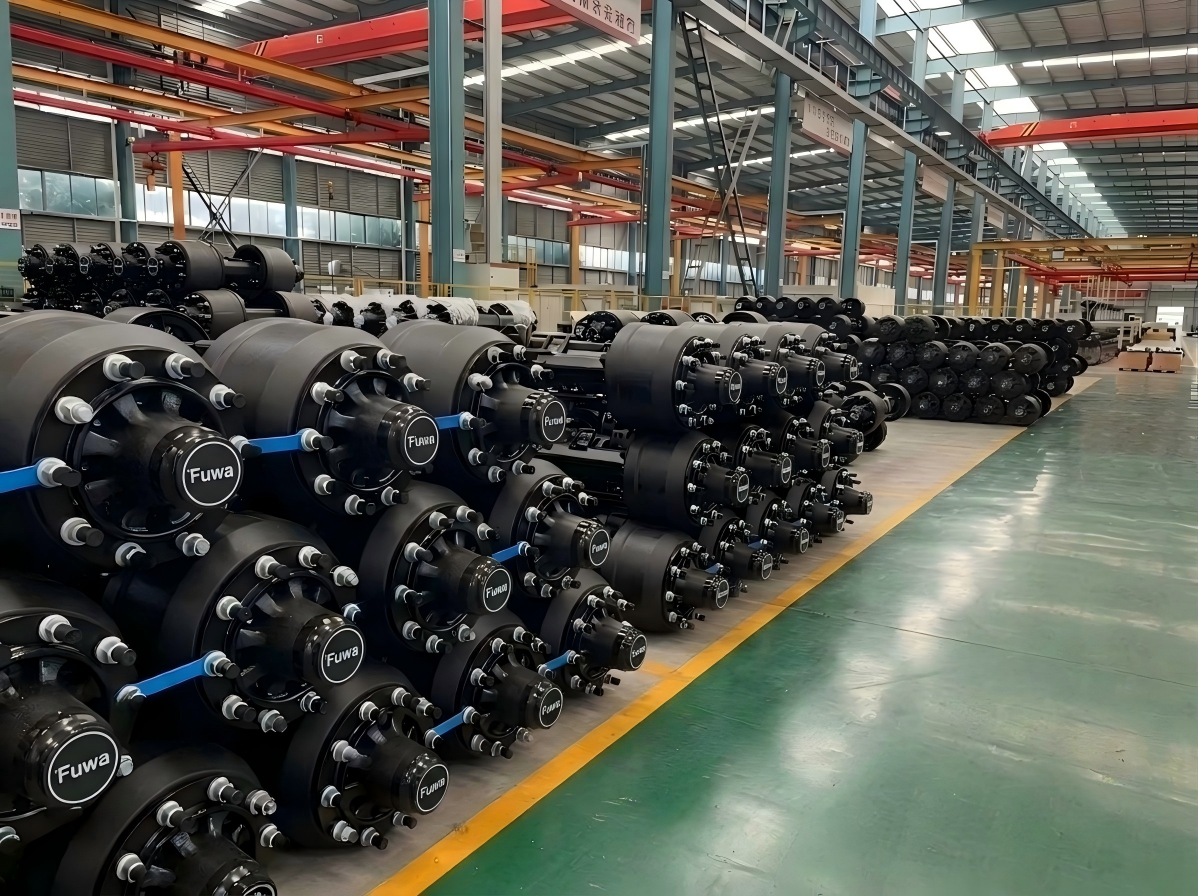
The axle assembly and chassis must be specified together. Axle rating, suspension geometry, tyre capacity, brake configuration and load distribution determine how forces are transferred from the road into the frame. Installing higher-rated axles does not automatically increase the legal payload or make an otherwise unsuitable chassis capable of carrying heavier cargo.

The supplied source identifies FUWA and BPW as established axle brands and recommends checking original product identification marks and anti-counterfeit codes where available. Buyers should confirm the exact manufacturer, model, rating and documentation stated in the quotation. An identifying mark is one verification point; it should be considered alongside supplier records and the agreed technical specification.

Semi trailer chassis axle installation showing FUWA and BPW axle identification, axle housings, hubs, brake assemblies and suspension mounting brackets

How Should You Evaluate 13-Ton, 16-Ton and 20-Ton Axles?

The supplied material describes 13-ton-class axles as a common option for long-distance transport, 16-ton-class axles as an option to evaluate for demanding heavy-load routes, and 20-ton-class or higher axles for heavy-duty engineering applications. These are reference points for discussing configurations, not universal recommendations. Rating definitions, component specifications and legal axle loads must be confirmed for the actual product and destination.

Axle classApplication to evaluateTechnical checks
13-ton classConventional freight operations where the complete vehicle meets the load requirementsAxle rating, tyre capacity, suspension compatibility and local axle-load limits.
16-ton classPotential candidate for demanding routes after engineering reviewBrake specification, tyre rating, frame design and load distribution.
20-ton class or aboveSpecialized heavy-duty applications requiring a complete system assessmentDocumented ratings, approved design and compliance with applicable limits.

A semi trailer chassis must distribute the cargo load appropriately across the axle group and kingpin. The actual load at each axle depends on the trailer geometry, coupling position, cargo centre of gravity and loading pattern. A nominal axle rating cannot be used as a substitute for a complete load-distribution assessment.

Before ordering, confirm axle spacing, suspension type, wheel and tyre specifications, brake components and replacement-part availability. For export fleets, the practical ability to source seals, bearings, brake components and other service items can affect vehicle uptime over the life of the trailer.

When a supplier proposes an alternative axle brand or model, require written approval before production. The replacement should be checked for rating, dimensions, mounting compatibility, braking performance and parts support rather than accepted on price alone.

Which Suspension System Is Suitable for Your Chassis?

Suspension selection should reflect cargo, road conditions, operating frequency, maintenance capability and the required ride characteristics. Leaf-spring suspension is often considered for demanding work where a straightforward mechanical arrangement and practical servicing are priorities. Air suspension may be suitable where ride quality and vibration management are important, provided the fleet can maintain the associated pneumatic components.

Semi trailer chassis suspension system showing heavy-duty leaf springs, air suspension bags, shock absorbers, axle brackets and mounting points
FactorLeaf-spring suspensionAir suspension
Primary considerationMechanical simplicity and serviceabilityRide characteristics and vibration control
Inspection focusSpring leaves, hangers, bushes, U-bolts and alignmentAir bags, valves, air lines, height-control components and shock absorbers
Maintenance planningCheck fasteners, wear, cracks and displaced componentsCheck leakage, ride height, air supply and damaged components
Selection priorityDuty cycle, road quality and local repair resourcesOperating requirements and system maintenance capability

For construction-material transport, quarry work and repeated short-haul cycles on uneven access roads, leaf-spring suspension may be worth evaluating where robustness and straightforward maintenance are priorities. For highway freight, air suspension may offer benefits for suitable applications. Neither arrangement is the correct choice for every semi trailer chassis.

Suspension mounting brackets must align with the approved design and the selected axle assembly. Incorrect alignment, loose fasteners, worn bushes and damaged springs can contribute to abnormal tyre wear and handling problems. Buyers should therefore inspect the entire suspension assembly rather than focusing exclusively on the spring type.

Ask the manufacturer to state the suspension brand or model, rated capacity, axle arrangement and any included accessories. If the destination market has limited access to specialized components, discuss service requirements before committing to an air suspension system or another configuration that depends on specific replacement parts.

How Should the Braking System Be Matched to the Chassis?

The braking system must be compatible with the trailer’s intended load, running gear, prime mover and destination regulations. ABS equipment should be explicitly included where required or selected, and the specification should identify the actual system and relevant components. Do not assume that every quoted trailer includes the same braking package.

Disc brakes can offer effective heat dissipation and stable braking characteristics in suitable applications. Drum brakes remain widely used in heavy-duty configurations and may be preferred where the design, maintenance resources and operating conditions support them. The correct selection depends on the complete system, not a general claim that one brake type is always superior.

Semi trailer chassis braking system with ABS wheel-speed sensors, air brake chambers, disc brake calipers, drum brake components and air lines

During the quotation and inspection process, verify these items:

  • Brake type, component model and compatibility with the selected axles.
  • ABS specification, sensor installation, wiring and electrical connectors where applicable.
  • Air brake chambers, reservoirs, lines, fittings and visible connections.
  • Availability of replacement brake components in the destination market.
  • Required approvals, test records and inspection documents.
  • Safe functional testing before the trailer enters service.

For routes with steep descents or sustained heavy loading, the complete vehicle’s braking capability and operating practices require particular attention. Trailer brake selection alone cannot prevent overheating under every condition. Proper adjustment, maintenance, suitable driving techniques and compliance with vehicle-weight restrictions remain important.

Specify the brake configuration in the purchase contract and have qualified personnel carry out the appropriate tests. If the trailer is being exported, confirm destination-specific braking and ABS requirements before the production specification is finalized.

WhatsApp Us to Confirm Axles and Brakes

When Should You Choose a Lightweight Semi Trailer Chassis?

A lightweight semi trailer chassis can increase the payload available within a legal gross-weight limit when the operation is weight-limited and the structural design remains suitable for the application. Potential weight-saving options include optimized high-strength steel sections, aluminium wheels and aluminium body components. Each option must be assessed for cost, durability, compatibility and the actual operating conditions.

The supplied source indicates that selected lightweight components may reduce tare weight by around half a tonne. This is an indicative figure, not a guaranteed saving for every trailer. The actual result depends on the baseline configuration, component choices, body type, axle package and accessories.

OptionPotential benefitPoints to verify
Optimized steel chassisPotential reduction in structural mass through engineering optimizationMaterial grade, design calculations, weld requirements and fatigue performance.
Aluminium wheelsPotential reduction in wheel and overall vehicle massLoad rating, compatibility, purchase cost and local availability.
Aluminium body componentsPotential weight reduction for compatible body designsImpact resistance, repair methods, cargo requirements and lifecycle cost.

Does a Lower Tare Weight Always Improve Profitability?

No. The commercial benefit depends on the legal payload limit, cargo density, route characteristics, trip frequency and cost of the lightweight configuration. A fleet carrying dense materials may be constrained by axle loads or gross vehicle weight. A fleet transporting lighter, bulky goods may be constrained by volume instead, making additional payload capacity less valuable.

Compare the complete configurations under the same legal operating limits. Ask for the expected tare weight with all selected options included, and clarify whether spare tyres, toolboxes, accessories and other items are counted. Where accurate weight is commercially important, arrange weighing of the completed trailer before shipment.

Never sacrifice structural suitability to achieve an attractive tare-weight figure. A semi trailer chassis must remain appropriate for the intended cargo and duty cycle. Any lightweight redesign should be supported by the manufacturer’s engineering assessment and documented specifications.

How Do You Inspect a Semi Trailer Chassis Before Delivery?

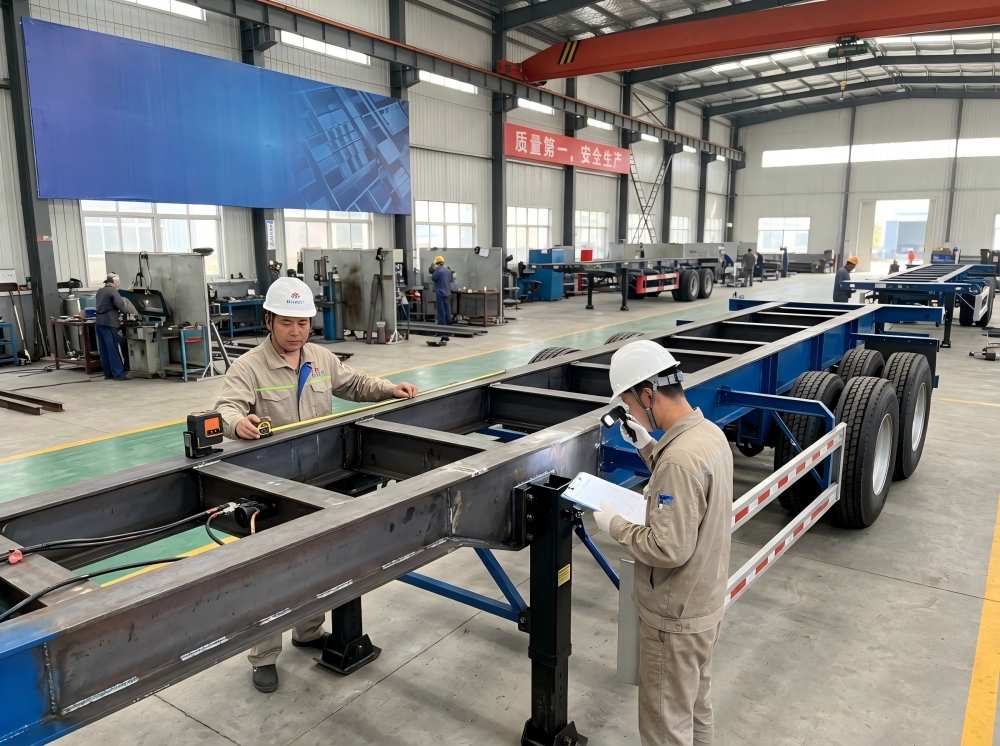
A structured factory inspection allows buyers to compare the finished trailer against the contract and approved drawings before acceptance. It can identify visible defects, missing components and configuration differences while corrective action is still practical. The inspection should cover the frame, running gear, accessories, surface protection and any specified functional tests.

Factory inspection of a semi trailer chassis checking main beam straightness, welding quality, crossmembers, axle installation, suspension brackets and trailer accessories

1. Check Main Beam Straightness and Welding

  • Inspect the visible main beam surfaces for bending, deformation or physical damage.
  • Examine accessible welds for cracks, missed welds, obvious discontinuities and inconsistent finishing.
  • Check the gooseneck or other reinforced transition areas against the approved design.
  • Count crossmembers and confirm their placement against the contract or drawing.
  • Check accessible fasteners and rivets for missing, loose or visibly corroded components.
  • Confirm that specified steel grades and plate dimensions are supported by the agreed documentation.

2. Verify Axles and Suspension

  • Check axle identification marks and model information against the purchase specification.
  • Inspect visible axle housings, hubs and seals for physical damage or signs of leakage.
  • Confirm the suspension type and axle arrangement match the approved configuration.
  • Check leaf springs for broken leaves, displacement and abnormal wear.
  • Inspect air bags, lines and fittings for visible damage or leakage where air suspension is installed.
  • Review brake chambers, ABS sensors, cables and connections for completeness and visible damage.
  • Verify tyre sizes, load ratings and brands against the contract.

3. Inspect the Deck, Body and Accessories

Check the deck or body panels for obvious deformation, damage, uneven surfaces and poor finishing. Inspect load restraint points, hinges, latches, doors and other moving components for proper operation. Confirm that the tool box, ladder, tarpaulin frame, spare-wheel carrier and other accessories are present where specified.

For a tipper semi trailer, inspect the body structure, hydraulic hoses, fittings, cylinder mounting points and lifting mechanism. Where the contract specifies hydraulic cylinder pressure testing, request the manufacturer’s test procedure and recorded results. Smooth lifting operation alone does not establish that a cylinder has passed a specified pressure test.

4. Carry Out Appropriate Functional Tests

Functional tests should be conducted by qualified personnel under controlled and safe conditions. Where required, connect the trailer to a compatible prime mover and verify the specified brake, lighting and coupling functions. A road test should be carried out only when permitted and safe; it does not replace a complete mechanical or braking inspection.

Record any defects or deviations with photographs, descriptions and references to the contract. Agree on corrective actions and verify their completion before final acceptance or shipment. For safety-critical applications, independent inspection or appropriate non-destructive testing may be necessary.

Recommended pre-delivery records

  • Approved chassis drawing and technical configuration sheet.
  • Component identification and material documentation where agreed.
  • Inspection checklist with dated photographs.
  • Applicable functional test or pressure-test records.
  • Written list of discrepancies and corrective actions.
  • Final acceptance record and agreed shipping documentation.

A visual inspection cannot confirm every hidden defect or establish the performance of every component. Use the inspection scope, technical records and suitable testing procedures specified in the purchase contract.

Discuss Factory Inspection Requirements

How Can Buyers Compare Semi Trailer Chassis Manufacturers?

The best way to compare chassis manufacturers is to request equivalent technical specifications and evaluate the complete supply scope. A lower quotation may reflect a different steel specification, lighter running gear, fewer accessories or a narrower inspection scope. Unless these differences are identified, the prices are not directly comparable.

Evaluation itemWhat the buyer should request
Chassis designApproved drawing, dimensions, material grade and specified plate thicknesses.
Running gearAxle brand, model, rating, suspension configuration and brake specification.
Tare weightConfiguration-specific weight with included options and exclusions clearly stated.
Manufacturing qualityInspection scope, applicable test records and agreed acceptance criteria.
After-sales serviceWarranty conditions, parts availability, technical support and claim procedures.
Export arrangementsDelivery scope, Incoterms, documentation responsibilities and shipping schedule.

Before and After: A More Reliable Procurement Process

Before: Comparing Price Alone

  • Steel grades and beam dimensions are not clearly stated.
  • Axle brands and ratings differ between quotations.
  • Accessories and inspection responsibilities remain unclear.
  • Warranty conditions are based on verbal discussions.
  • Import requirements are checked after production starts.

After: Comparing Written Specifications

  • All suppliers quote against the same technical sheet.
  • Critical components and approved alternatives are documented.
  • Inspection, accessories and delivery scope are itemized.
  • Warranty and corrective-action procedures are agreed in writing.
  • Destination requirements are reviewed before manufacturing.

This process helps procurement teams evaluate the real commercial value of a semi trailer chassis. The lowest initial price is not necessarily the lowest ownership cost. Maintenance, downtime, tyre wear, parts supply, payload efficiency and the expected service life can all influence operating economics.

For international orders, define the payment terms, delivery responsibilities, inspection milestones, warranty provisions and required documentation in the contract. Confirm the destination country’s vehicle, customs and import requirements with the relevant authorities or a qualified customs broker.

What Should Export Buyers Confirm Before Shipment?

Export buyers should finalize the semi trailer chassis configuration and documentation requirements before production is completed. The chassis must be compatible with the prime mover and intended application, while the finished trailer must meet applicable destination-market requirements. Early verification reduces the likelihood of late changes, missing documents or avoidable shipping delays.

Prime Mover and Kingpin Compatibility

Provide the tractor model and relevant coupling specifications. Confirm the fifth-wheel height, kingpin dimensions, coupling compatibility, electrical connectors and air-brake connections. The tractor’s permitted axle loads and the intended cargo distribution must also be considered when assessing the complete vehicle combination.

Dimensions, Payload and Local Regulations

Confirm overall length, width, height, axle spacing, ground clearance and other relevant dimensions. Provide cargo dimensions and the expected loading pattern so the supplier can assess the intended application. Verify the destination’s axle-load limits, gross vehicle weight rules, braking requirements, lighting regulations and registration conditions before placing the order.

Export Documents and Shipping Arrangements

Agree on the documents required for the transaction, which may include a commercial invoice, packing list and transport document, together with technical or conformity records where applicable. Requirements vary by destination, product classification and transaction structure, so the buyer should confirm the exact document list with the importer or customs broker.

Shipping arrangements should reflect the finished trailer’s actual dimensions, weight, loading method and lashing requirements. Confirm the carrier’s acceptance conditions and whether the selected transport method is suitable for the trailer configuration. Do not assume that all semi trailers can be shipped under the same arrangements.

ZW Group encourages buyers to provide their destination market, technical specifications and inspection requirements when requesting a quotation. This gives both sides a clearer basis for confirming the configuration, commercial scope and delivery arrangements.

Frequently Asked Questions About Semi Trailer Chassis

What is the most important part of a semi trailer chassis?

The main beams are central structural components because they carry bending loads and transfer forces through the chassis. However, overall performance also depends on the crossmembers, kingpin area, suspension mounting points, welds, axles and complete vehicle design.

What steel thickness should a semi trailer chassis use?

The supplied source lists an 8 mm upper flange, a 10 mm lower flange and a 6 mm web plate as a reference configuration. These dimensions are not universal requirements. The appropriate thickness depends on the steel grade, beam geometry, loading assumptions and engineering design. Request the approved specification for your trailer.

Is high-strength steel better than ordinary Q235 steel?

High-strength steel can provide higher specified strength properties and may support an optimized structural design. The actual benefit depends on the precise grade, fabrication process and chassis engineering. Confirm the material designation and relevant documentation before comparing steel specifications.

How do I select a heavy-duty semi trailer chassis?

Start with cargo type, payload, load distribution, route conditions, prime mover specifications and local legal limits. Then evaluate the main beam design, axle ratings, suspension, braking system and tare weight as a complete configuration. Heavy-duty use should be supported by a suitable engineering specification.

Are FUWA and BPW axles suitable for export trailers?

They are established axle brands identified in the supplied source material. Suitability depends on the exact model, rating, trailer configuration, destination requirements and local parts availability. Confirm the specified product and its documentation rather than relying on the brand name alone.

Should I choose leaf-spring or air suspension?

Leaf-spring suspension may suit operations that prioritize straightforward mechanical servicing and robust construction. Air suspension may be appropriate where ride characteristics and vibration management are important. The choice should reflect the duty cycle, maintenance capability and full operating cost.

How can I reduce semi trailer chassis maintenance costs?

Specify components suited to the operating conditions, confirm replacement-part availability, inspect the chassis and running gear before delivery, and follow an appropriate maintenance schedule. Correct loading, tyre maintenance, suspension checks and timely repair can help reduce avoidable downtime.

Can a lightweight chassis carry more cargo?

A lower tare weight can increase available payload when the vehicle is limited by legal gross weight and the chassis remains suitable for the application. The actual benefit depends on the configuration, cargo, axle loads and local regulations. Request the finished trailer’s specified tare weight and verify the delivered unit when required.

What should I inspect before accepting a semi trailer chassis?

Inspect the main beams, accessible welds, crossmembers, reinforcement, axle identification, suspension, brakes, tyres, body accessories and specified test records. Compare the finished trailer against the approved drawing and contract. Record defects and confirm corrective actions before acceptance.

What information should I send to a semi trailer chassis manufacturer?

Provide the trailer type, cargo, target payload, destination country, prime mover model, route conditions, required dimensions, axle and suspension preferences, braking requirements, quantity and delivery schedule. Any available drawings or local compliance requirements will also help establish the correct specification.

How can I avoid receiving a different chassis configuration from the one ordered?

Record the steel grade, plate dimensions, chassis drawing, axle brand and rating, suspension, braking system, tyres, accessories, inspection requirements and approved alternatives in the purchase contract. Review the finished trailer against these documents before shipment.

Need a Semi Trailer Chassis Configuration for Your Market?

Choose your chassis based on the actual transport task, not just the purchase price. ZW Group works with international commercial vehicle buyers evaluating chassis structure, steel specifications, axle assemblies, suspension, braking systems and export requirements.

Send us your cargo type, target payload, destination country, prime mover details and preferred configuration. Our team can review your requirements and prepare a quotation based on the agreed technical scope.

For bulk orders, dealer inquiries and project procurement, include your required quantity, delivery schedule and inspection conditions. Confirming the specification in writing helps establish a clear basis for manufacturing, acceptance and shipment.

Contact ZW Group

ZW Group | Semi Trailer Chassis Manufacturing and Export

China Vehicle Supplier
China Vehicle Supplier at Lagos Expo 2026 | ZW Group

THE 19TH CHINA COMMODITIES EXPO · NIGERIA LAGOS

How Can a China Vehicle Supplier Help Nigerian Buyers Source Trucks and Semi-Trailers?

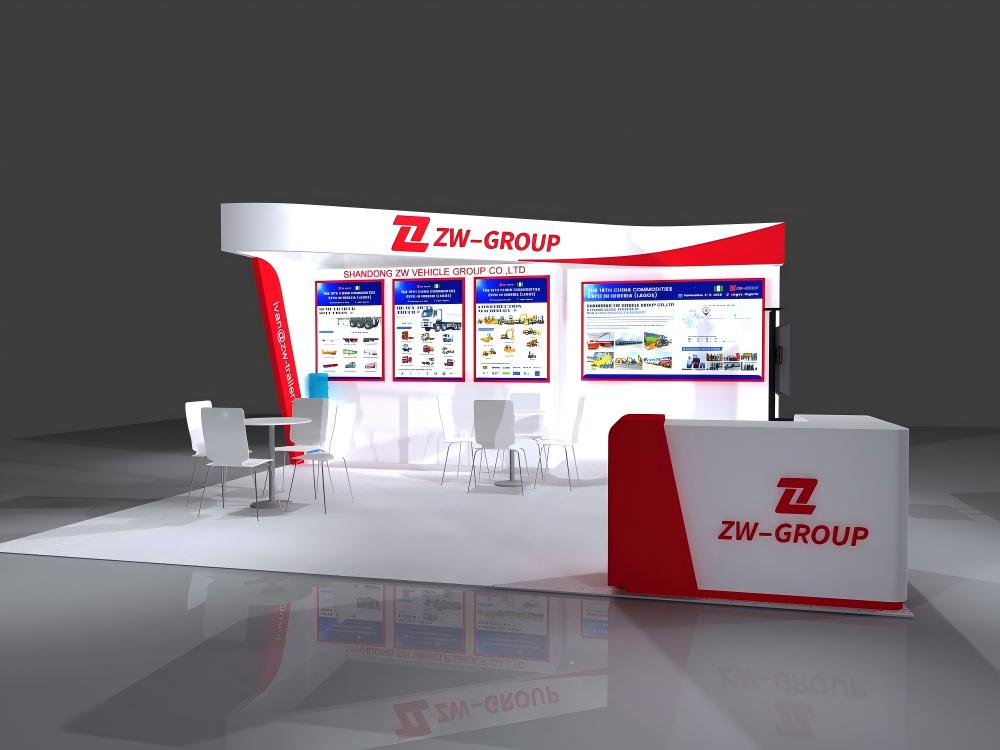
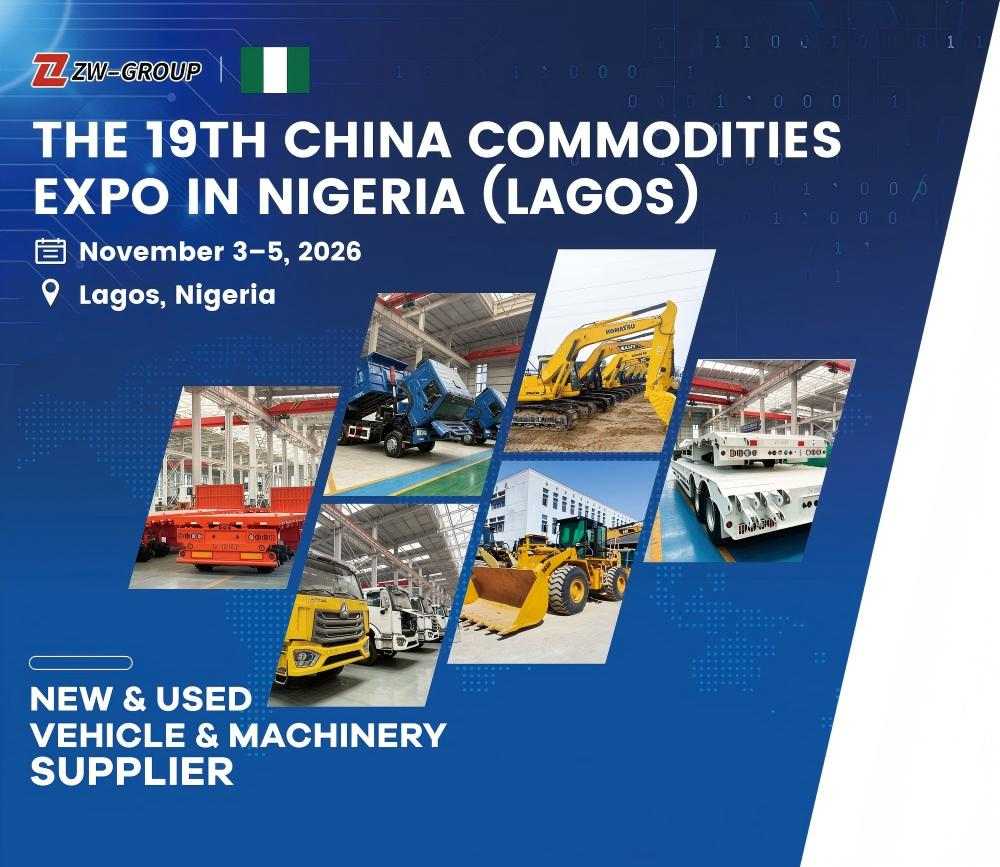
Meet ZW Group at Booth 1A01, Landmark Centre, Lagos, from November 3–5, 2026. Discuss commercial vehicles, semi-trailers, construction machinery, and new or used vehicle procurement with our team.

For Nigerian importers, fleet operators, construction contractors, mining businesses, and regional distributors, choosing a China vehicle supplier involves more than comparing purchase prices. Vehicle configuration, operating conditions, export arrangements, spare parts, and long-term serviceability all influence the actual cost of ownership.

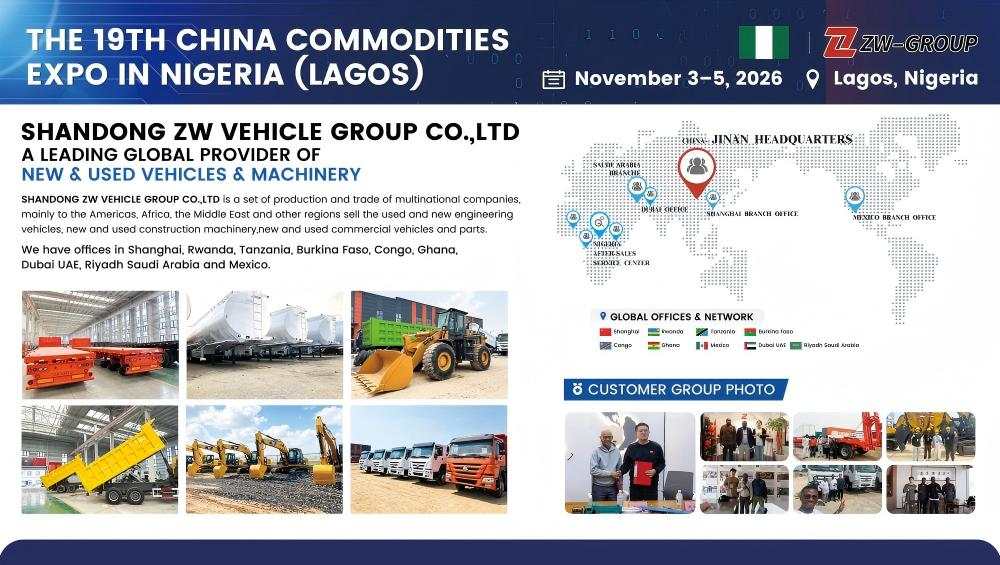
ZW Group connects Chinese vehicle manufacturing resources with overseas commercial requirements. At the Lagos exhibition, visitors can discuss equipment selection, fleet procurement, project requirements, and potential long-term supply cooperation.

Contact ZW Group on WhatsApp

What Are the Key Details of the 2026 Lagos China Commodities Expo?

Visit ZW Group at Booth 1A01 to discuss vehicle specifications and export purchasing requirements directly with our team. Advance contact helps us prepare for more focused business discussions.

Event DetailInformation
ExhibitionThe 19th China Commodities Expo Nigeria Lagos
DatesNovember 3–5, 2026
VenueLandmark Centre, Lagos, Nigeria
ZW Group Booth1A01
Product ScopeSemi-trailers, heavy trucks, new and used vehicles, construction machinery, and related procurement solutions
ContactWhatsApp: +86 185 6091 3665
China vehicle supplier ZW Group exhibition stand at the 2026 Lagos China Commodities Expo displaying semi-trailers heavy trucks and commercial vehicle export solutions

Exhibition image placeholder: replace with the confirmed ZW Group booth or event promotional image.

Lagos is an important commercial centre for Nigerian imports, distribution, industrial activity, and regional trade. Buyers from across Nigeria and neighbouring West African markets can use the exhibition to establish direct supplier contacts and discuss their actual operating requirements.

A face-to-face meeting can also help clarify details that are easily overlooked in a short online inquiry. These include axle configuration, payload requirements, intended road conditions, truck powertrain options, delivery arrangements, and the availability of suitable replacement parts.

Why Should Nigerian Buyers Meet a China Vehicle Supplier in Person?

The most useful supplier meeting starts with the buyer’s operating conditions, not a generic price list. A vehicle must suit its intended workload, road environment, maintenance resources, and expected operating life.

For a fleet operator, the wrong specification can increase fuel consumption, tyre wear, maintenance downtime, and repair costs. For an importer or distributor, an unsuitable configuration can make inventory harder to sell and after-sales support more complicated. For a contractor, poor equipment matching can disrupt an entire project schedule.

ZW Group welcomes discussions with buyers who need to evaluate:

  • Vehicle types and technical specifications for specific applications.
  • New versus used heavy-truck procurement options.
  • Trailer dimensions, axle arrangements, suspension systems, and load requirements.
  • Engine, transmission, braking, and drivetrain options where applicable.
  • Spare parts planning and maintenance considerations.
  • Export documentation, shipping arrangements, and destination-port requirements.
  • Single-unit purchases, fleet orders, and distributor supply opportunities.

A capable China vehicle supplier should be prepared to ask practical questions before recommending a configuration. What cargo will the vehicle carry? How far will it travel each day? Will it operate on paved highways, construction access roads, or mining routes? What maintenance facilities and replacement parts are available locally?

These answers provide a better basis for evaluating suitable vehicles than horsepower or purchase price alone.

WhatsApp ZW Group before the exhibition to arrange a focused discussion.

What Semi-Trailers Can Buyers Discuss with ZW Group?

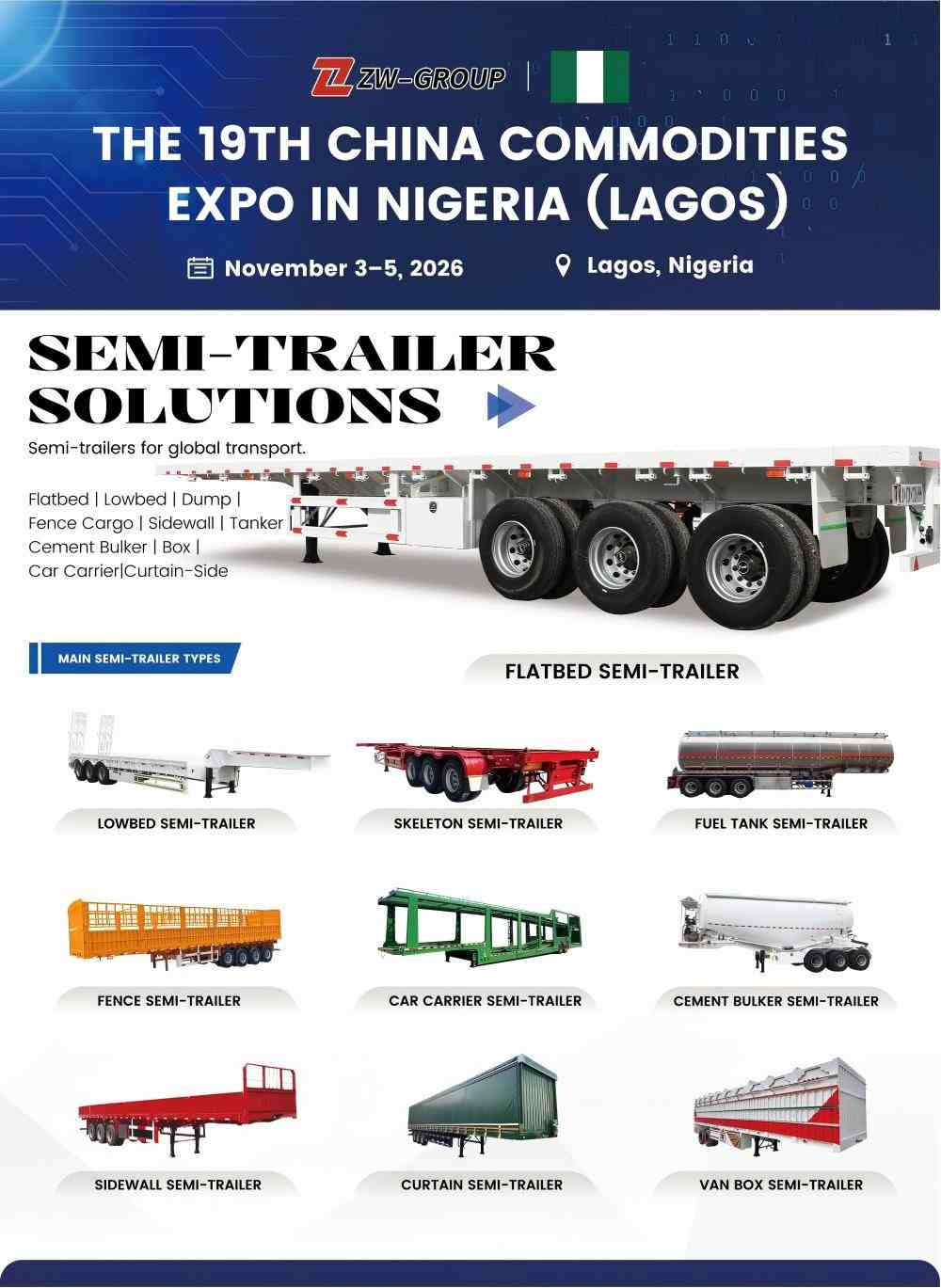
ZW Group offers access to multiple semi-trailer categories for freight transportation, container logistics, construction, and industrial applications. The appropriate model depends on cargo dimensions, loading methods, route conditions, axle loads, and applicable local regulations.

Trailer TypeTypical ApplicationSpecification Points to Confirm
Flatbed Semi-TrailerSteel products, building materials, machinery, and general cargoDeck dimensions, payload, axle layout, loading access, and lashing points
Lowbed Semi-TrailerExcavators, loaders, bulldozers, and other heavy equipmentPlatform height, loading ramps, axle capacity, turning clearance, and cargo dimensions
Dump Semi-TrailerSand, aggregate, earth, and bulk construction materialsBody volume, steel thickness, hydraulic hoist, tipping angle, and chassis design
Fence Cargo Semi-TrailerBagged cargo, agricultural goods, packaged materials, and mixed freightFence height, post arrangement, deck structure, and load securing
Sidewall Semi-TrailerGeneral cargo requiring side protectionSidewall height, removable panels, payload, and loading requirements
Fuel Tank Semi-TrailerBulk liquid transport where permittedTank material, compartments, valves, safety equipment, and applicable certification
Skeleton Container TrailerShipping-container transport between ports, depots, and inland destinationsContainer compatibility, twist locks, chassis dimensions, and axle loading
Cement Bulker Semi-TrailerDry cement and other compatible powdered bulk materialsTank capacity, discharge arrangement, compressor requirements, and material compatibility
Car Carrier Semi-TrailerTransport of passenger cars and compatible light vehiclesVehicle capacity, loading geometry, ramps, restraint points, and overall dimensions
China vehicle supplier ZW Group semi-trailer range including flatbed lowbed dump fence cargo fuel tanker skeleton container cement bulker and car carrier trailers

Image placeholder: insert a real product lineup photograph showing the relevant trailer categories.

How Should You Select a Trailer for Nigerian Operations?

Start with cargo, route, loading equipment, and legal limits. Trailer selection should follow the complete operating task rather than a standard configuration chosen without supporting information.

Port and container operators often prioritise chassis strength, container compatibility, tyre availability, and axle-load distribution. Construction contractors may require a lowbed with appropriate deck height, ramp geometry, and loading capacity. Aggregate hauliers typically need a dump body and hydraulic system suited to their materials and discharge site.

For long-distance freight, tare weight and structural durability affect payload economics. However, reducing tare weight must not compromise structural integrity or legal operating limits. High-tensile steel, where specified and appropriately engineered, can help balance strength and weight. Actual performance depends on material grade, section design, welding quality, and manufacturing controls.

Suspension selection also matters. Leaf-spring and air-suspension arrangements have different operating characteristics, maintenance requirements, and application suitability. Axle ratings, braking components, tyre specifications, kingpin dimensions, fifth-wheel compatibility, and electrical connections must be checked against the intended tractor unit.

For a fuel tanker, buyers must establish the intended liquid, compartment arrangement, filling and discharge requirements, and applicable transport regulations. For a cement bulker, compressor capacity and unloading equipment compatibility can affect turnaround time at the delivery site.

ZW Group can discuss these requirements with buyers seeking a China vehicle supplier for a specific transport operation. Final specifications should be confirmed in a written technical quotation before an order is placed.

Send your trailer type, cargo, target payload, and destination to ZW Group on WhatsApp.

How Can ZW Group Help Buyers Source Heavy Trucks?

ZW Group helps overseas buyers explore new and used heavy-truck procurement options based on the intended application, vehicle condition requirements, budget, and destination market.

Demand across Nigeria and West Africa can involve port haulage, construction materials, mineral transport, agricultural logistics, infrastructure projects, and general road freight. Each application places different demands on the prime mover, drivetrain, chassis, tyres, cooling system, and braking equipment.

Which Truck Brands Can Buyers Discuss?

  • HOWO: A range of heavy commercial vehicles for applications such as hauling, tractor-trailer operations, and construction transport.
  • Shacman: Heavy-truck options that buyers may evaluate for demanding freight and construction duties.
  • Foton: Commercial vehicle options for buyers assessing cargo transport and fleet requirements.
  • FAW: Heavy and commercial vehicle options for different transport applications.
  • Beiben Heavy-truck options that can be considered according to the intended duty cycle and required specification.
  • Availability, model year, configuration, and supply terms vary by vehicle and order. Buyers should request the exact model designation, engine rating, transmission specification, axle configuration, and production or registration details for the units under consideration.

    China vehicle supplier ZW Group sourcing HOWO Shacman Foton FAW and Beiben heavy trucks for Nigerian transport fleets and West African commercial vehicle buyers

    Image placeholder: replace with actual truck photographs and accurate model captions.

    What Heavy-Truck Applications Can Be Discussed?

    Vehicle TypeTypical WorkKey Checks
    Dump Truck / TipperAggregate, earthmoving, quarrying, and construction materialsEngine output, axle configuration, payload, body design, and hydraulic hoist
    Tractor Truck / Prime MoverContainer, flatbed, tanker, and other semi-trailer operationsFifth wheel, kingpin compatibility, axle ratio, transmission, and gross combination limits
    Concrete Mixer TruckConcrete delivery for construction projectsDrum capacity, chassis suitability, hydraulic drive, and operating weight
    Water Tank TruckConstruction water supply, dust control, and compatible utility applicationsTank capacity, pump and spray arrangement, chassis load, and intended use
    Fuel Tank TruckFuel distribution where regulatory requirements are metTank configuration, safety equipment, valves, documentation, and certification
    Cargo TruckGeneral goods and commercial freightBody dimensions, axle ratings, payload, and route restrictions

    A China vehicle supplier should match the engine and drivetrain to the operating task. High engine power alone does not guarantee lower operating costs. Gear ratios, torque delivery, vehicle mass, tyre selection, road gradients, payload, and driving practices all affect fuel use and performance.

    For a prime mover, the fifth wheel and trailer kingpin must be compatible. Fifth-wheel load rating, mounting position, coupling height, and overall combination geometry require verification. Differential locks may assist traction in appropriate conditions, but they do not replace correct axle loading, tyres, and safe driving procedures.

    For a tipper, the hydraulic hoist, cylinder arrangement, body structure, hinge points, and subframe must suit the load and discharge environment. Buyers should confirm the rated payload and the vehicle’s legal gross and axle limits rather than relying only on body volume.

Should You Buy New or Used Heavy Trucks from China?

The right choice depends on acquisition budget, expected utilisation, downtime tolerance, and inspection evidence. New and used vehicles can both fit a procurement strategy, but their risks and cost structures differ.

Decision FactorNew VehicleUsed Vehicle
Initial PurchaseUsually requires a higher initial budgetMay offer a lower entry cost, depending on condition and specification
Condition AssessmentFocus on specification, manufacturing quality, and pre-delivery checksRequires careful review of wear, maintenance history, and mechanical condition
Maintenance PlanningFollow the manufacturer’s service schedule and specified parts requirementsAllow for condition-dependent repairs and replacement of worn components
ConfigurationDepends on available models and confirmed order specificationsDepends on the actual vehicle offered and its existing configuration
Best Evaluation MethodVerify the build specification and delivery conditionInspect the actual unit, supporting records, and test results where available

A used truck should never be assessed solely by exterior appearance or a seller’s description. Buyers should request available chassis and engine identification details, mileage records, service history, photographs, videos, and inspection findings. Actual verification depends on the unit and the records available.

For a used dump truck, inspection should consider chassis cracks or deformation, signs of previous repairs, hydraulic leakage, cylinder condition, body and subframe wear, transmission operation, differential noise, cooling performance, and braking condition. A cylinder pressure test or other engine test may be appropriate when supported by the engine design and inspection procedure. Results should be documented rather than assumed.

For a used tractor truck, pay attention to clutch operation, gearbox performance, differential condition, fifth-wheel wear, steering play, suspension components, air-brake performance, and the condition of the engine and cooling system. A road test, diagnostic scan, or workshop inspection may be appropriate where available and safe.

Before committing funds, compare the purchase price with shipping, insurance, import duties, taxes, registration, initial maintenance, replacement parts, and any required modifications. A lower purchase price is not automatically a lower total cost of ownership.

Contact ZW Group on WhatsApp to discuss new or used truck requirements and request unit-specific information.

How Should Buyers Evaluate Vehicle Quality and Technical Specifications?

A clear technical specification and documented inspection process reduce uncertainty before export. Buyers should establish what is included in the quoted vehicle, what evidence can be supplied, and which requirements must be confirmed before shipment.

Trailer Chassis and Structural Quality

The main beam carries major structural loads and must be engineered for the intended application. Buyers should ask about the specified steel grade, beam dimensions, cross-member arrangement, welding process, surface preparation, and corrosion-protection system. High-tensile steel can support a strength-to-weight target when correctly selected and processed, but the material name alone does not establish the quality of the finished trailer.

Axle capacity must be evaluated alongside tyre ratings, suspension design, braking components, and legal load distribution. Overloading any component can increase failure risk and shorten service life. A written specification should state the axle arrangement and relevant component ratings wherever applicable.

Hydraulic Systems for Dump Applications

For a dump trailer or tipper truck, the hydraulic system must match the body geometry, rated load, and discharge procedure. Buyers should confirm the hoist type, cylinder specification, operating pressure where provided, hydraulic power source, hose routing, and maintenance access. The system should be inspected for leakage, damage, secure connections, and smooth operation under an appropriate test procedure.

Never assume a cylinder is suitable merely because it can raise an unloaded body. The working load, tipping angle, body centre of gravity, chassis stability, and ground conditions affect safe unloading. Operators should follow the equipment instructions and avoid tipping on unsuitable or unstable ground.

Prime Mover and Drivetrain Compatibility

Truck and trailer compatibility affects safety, handling, and operating efficiency. Confirm the fifth-wheel rating, kingpin specification, coupling height, trailer clearance, axle loading, electrical connections, and braking interfaces. The engine, gearbox, axle ratio, and differential configuration should be suitable for the expected combination mass, terrain, and operating cycle.

Where inter-axle differential locks are fitted, the operating instructions and engagement limitations should be understood. Differential locks can improve traction in certain conditions, but improper use on high-grip surfaces may cause drivetrain stress or handling problems.

Documentation and Pre-Shipment Verification

  • Confirm the exact make, model, year, and vehicle identification details.
  • Match the commercial invoice and packing information to the actual shipment.
  • Review the applicable export, shipping, and destination-market documents.
  • Confirm whether inspection records, photographs, videos, or test results are available.
  • Check the agreed configuration against the final pro forma invoice and purchase contract.
  • Clarify the allocation of responsibility for freight, insurance, customs clearance, and destination charges.

Inspection scope should be agreed before payment and shipment. A supplier should not claim a particular test, certification, or inspection result unless it has been performed and documented for the relevant unit or production batch.

How Does Vehicle Configuration Affect Operating Costs in Nigeria?

The lowest quotation is not always the lowest-cost procurement decision. Fuel consumption, tyre life, repair frequency, load utilisation, and downtime can outweigh an initial price difference over a vehicle’s working life.

Consider two hypothetical fleet procurement approaches. The comparison below illustrates decision factors; it does not represent measured ZW Group customer results.

Procurement ApproachPossible Short-Term ResultPotential Long-Term Consequence
Before: Choose mainly by advertised priceFaster comparison of headline quotationsConfiguration mismatch, unexpected maintenance, or higher operating costs may emerge
After: Match specifications to the duty cycleMore detailed technical and commercial evaluationBetter visibility into payload suitability, maintenance needs, and lifecycle cost drivers

For a fleet working long-distance routes, a suitable powertrain and axle ratio can matter more than selecting the highest available horsepower. For quarry or construction use, chassis strength, cooling, tyres, ground clearance, and the suitability of the dump body may be more important than highway fuel economy alone.

Tyre selection should reflect axle loading, road conditions, speed, availability, and maintenance practices. A tyre specification that is difficult to replace locally can create additional downtime even if the original unit price is attractive.

Maintenance planning should include filters, lubricants, brake components, belts, hoses, lighting, electrical parts, and application-specific wear items. Buyers should identify locally available consumables and determine which specialist components may need longer procurement lead times.

For importers, stock planning also matters. Carrying too many uncommon configurations can tie up working capital and complicate after-sales support. A focused product range built around local customer demand may be easier to support than an assortment of unrelated models.

A practical China vehicle supplier discussion should therefore cover not only the vehicle itself, but also expected utilisation, maintenance capability, spare parts strategy, and the intended replacement cycle.

What Export and Customs Details Should Nigerian Importers Confirm?

Confirm destination requirements before finalising a purchase. Vehicle eligibility, documentation, import procedures, duties, taxes, inspection requirements, and port charges can change the total landed cost and the time needed to place equipment into service.

Importers should verify current requirements with the relevant Nigerian authorities, customs professionals, shipping agents, and other qualified service providers. Do not rely on a general quotation or an older shipment as proof that every vehicle configuration is currently admissible.

Questions to Resolve Before Shipment

  • Vehicle eligibility: Is the vehicle type, age, specification, and intended use permitted under current destination rules?
  • Documentation: Which commercial, transport, vehicle-identification, and regulatory documents are required?
  • Shipping method: Is containerised transport, RoRo, or another suitable method available for the particular vehicle?
  • Dimensions and weight: Do the vehicle’s dimensions and shipping weight affect freight selection or handling arrangements?
  • Insurance: What cargo insurance is required, and what risks and exclusions apply?
  • Customs clearance: Which party handles the clearance process, and what destination charges are excluded from the quoted price?
  • Final delivery: How will the vehicle move from the port to the buyer’s premises or project site?

For a semi-trailer, shipping arrangements may depend on its dimensions, configuration, and the selected carrier’s requirements. For a complete truck, buyers should confirm whether the quotation covers the vehicle only or also includes particular shipping, insurance, handling, or delivery services.

Commercial terms should clearly identify the agreed Incoterms rule and named place or port where applicable. Buyers should also confirm payment milestones, production or preparation lead time, inspection arrangements, and the documents to be provided before shipment.

ZW Group welcomes these discussions during the Lagos exhibition. The final import decision should be based on current official requirements and a written commercial agreement that identifies each party’s responsibilities.

Discuss Your Export Requirements with ZW Group

How Can ZW Group Support Project and Fleet Procurement?

ZW Group can discuss vehicle sourcing around a defined project, fleet plan, or distribution strategy rather than treating every inquiry as an isolated unit purchase.

For a mining or quarry operation, procurement may involve dump trucks, tractor units, lowbed trailers for equipment relocation, and support vehicles. For a logistics company, the requirement may centre on prime movers, container skeleton trailers, flatbeds, and general cargo trailers. Construction contractors may need a combination of heavy trucks, mixers, water tankers, and equipment transport solutions.

The most effective starting point is a list of the actual work to be performed. Include cargo type, payload, route length, road conditions, daily utilisation, site access, and the equipment already in the fleet. This information helps the supplier identify relevant configurations and highlight points that require further confirmation.

What Should a Fleet Procurement Brief Include?

  1. Destination country and intended operating location.
  2. Vehicle category and intended application.
  3. Required quantity and preferred delivery schedule.
  4. Payload, body volume, axle configuration, and other essential technical requirements.
  5. Preference for new vehicles, used vehicles, or both.
  6. Target purchase budget and whether freight is included.
  7. Maintenance resources, spare-parts expectations, and any required technical support.
  8. Applicable import, registration, and project compliance requirements.

For batch orders, buyers should agree on a consistent specification and identify any permitted variations between units. The purchase contract should record key configuration details and clarify the inspection, delivery, and acceptance process. This helps prevent misunderstandings when several vehicles or trailer units are involved.

For distributors, the discussion may also cover market demand, suitable product categories, model availability, and how to prioritise a manageable range. Territory exclusivity, credit terms, warranty coverage, and other special arrangements must never be assumed; they require separate written agreement.

Why Work with ZW Group as Your China Vehicle Supplier?

ZW Group’s stated business scope connects overseas customers with new semi-trailers, new and used heavy trucks, construction machinery, spare parts, and overseas customer service resources.

The company’s international business coverage includes China-based operations, an Africa-focused service team, a Middle East office, and activity in Latin American markets. These resources are intended to support discussions with transport businesses, mining companies, contractors, and project supply chains.

For Nigerian and West African buyers, the value of working with a China vehicle supplier should be evaluated through the clarity of the quotation, the relevance of the offered configuration, the quality of supporting information, and the supplier’s ability to communicate throughout the procurement process.

What Buyers Should Expect from a Professional Supplier Discussion

  • A clear explanation of the offered vehicle category and specification.
  • Identification of information still needed to confirm suitability.
  • A transparent breakdown of included and excluded commercial items.
  • Available photographs, technical documents, and inspection evidence relevant to the actual unit.
  • Clear discussion of export arrangements and destination responsibilities.
  • A practical channel for follow-up questions and quotation revisions.

ZW Group encourages buyers to raise difficult questions before placing an order. If a specification is not confirmed, it should be recorded as pending rather than presented as a guaranteed feature. If a used vehicle’s service history is incomplete, that limitation should be addressed during the evaluation.

This approach gives both sides a more reliable basis for a commercial decision. It also helps buyers distinguish between a low headline price and a proposal that properly reflects their operating needs.

ZW Group China vehicle supplier export team discussing truck procurement semi-trailer specifications and construction machinery sourcing with African B2B buyers

Image placeholder: insert an authentic ZW Group team or customer-meeting photograph.

Who Should Visit ZW Group at Booth 1A01?

Our exhibition team welcomes professionals involved in vehicle purchasing, import distribution, fleet management, construction, mining, and industrial transport.

  • Vehicle importers: Discuss sourcing options, specifications, and shipping arrangements.
  • Dealers and distributors: Explore product categories that fit your customer base and regional market.
  • Fleet operators: Review truck and trailer configurations for existing or planned operations.
  • Mining and quarry businesses: Discuss hauling equipment and heavy-equipment transport requirements.
  • Construction contractors: Evaluate vehicle categories for material delivery, site logistics, and machinery transport.
  • Project procurement teams: Align vehicle specifications, quantities, schedules, and documentation requirements.
  • Established customers: Review repeat orders, additional vehicle categories, and future procurement plans.

Whether you need one vehicle or are planning a larger fleet purchase, bring your operating requirements to the discussion. Accurate specifications help both sides focus on relevant options.

Book a Meeting via WhatsApp

How Do You Arrange a Meeting with ZW Group in Lagos?

Send your basic requirements before the exhibition so the team can prepare for a more productive conversation. A detailed technical specification is helpful, but an initial inquiry can begin with only the vehicle category, destination, and approximate quantity.

Include the following information where available:

  • Your company name and business role.
  • The required vehicle or trailer category.
  • Quantity and preferred delivery timeframe.
  • Country and intended operating location.
  • Application, cargo type, or project description.
  • Key technical specifications and target budget.
  • Whether you need new vehicles, used vehicles, or a combination.

ZW Group can then use the information to guide the discussion toward relevant vehicle categories and commercial questions. Any final offer remains subject to confirmed availability, technical specifications, and agreed terms.

WhatsApp: +86 185 6091 3665

Website: zwgroup-vehicle.com

Exhibition: The 19th China Commodities Expo Nigeria Lagos
Date: November 3–5, 2026
Venue: Landmark Centre, Lagos, Nigeria
Booth: 1A01

Frequently Asked Questions About Choosing a China Vehicle Supplier

What products can I discuss with ZW Group at the Lagos exhibition?

You can discuss semi-trailers, heavy trucks, new and used vehicles, construction machinery, spare parts, and vehicle procurement requirements. Exact availability and configuration must be confirmed for each inquiry.

Where can I meet ZW Group in Nigeria in November 2026?

Visit Booth 1A01 at the 19th China Commodities Expo Nigeria Lagos, held at Landmark Centre, Lagos, from November 3 to 5, 2026.

Can ZW Group help me source used heavy trucks?

ZW Group’s business scope includes used heavy-truck export solutions. Ask for the specific vehicle details, condition information, available inspection evidence, and commercial terms before deciding.

Which semi-trailer is suitable for Nigerian freight operations?

The answer depends on the cargo, payload, route, loading method, tractor unit, and applicable regulations. Flatbeds, dump trailers, fence cargo trailers, lowbeds, and container skeleton trailers serve different purposes. Provide your operating details to identify suitable options.

Can I request HOWO or Shacman trucks?

Yes. HOWO and Shacman are among the truck brands buyers can discuss with ZW Group. Specify the application, axle configuration, power requirements, and whether you are seeking new or used vehicles.

What information is needed for a quotation?

Provide the product category, quantity, destination, application, key specifications, and preferred delivery schedule. For used vehicles, identify the model and condition requirements. A formal quotation depends on confirmed product details and availability.

Can ZW Group discuss bulk purchases and dealership cooperation?

ZW Group welcomes inquiries from importers, distributors, fleet operators, and project procurement teams. Order quantities, supply schedules, commercial terms, and any dealership arrangements require individual discussion and written confirmation.

Can ZW Group advise on Nigerian customs clearance?

The team can discuss export and shipping arrangements relevant to a proposed purchase. Buyers should independently verify current Nigerian import eligibility, customs requirements, duties, taxes, and registration obligations with qualified local professionals and the relevant authorities.

How can I contact ZW Group before the exhibition?

Contact the team on WhatsApp at +86 185 6091 3665 or visit zwgroup-vehicle.com. Include your product requirements and destination to make the initial discussion more efficient.

Meet Your China Vehicle Supplier in Lagos

Choosing a commercial vehicle supplier is a decision about more than equipment acquisition. It affects operating reliability, maintenance planning, cargo productivity, and the long-term economics of your fleet.

At the 2026 Lagos China Commodities Expo, ZW Group invites Nigerian and West African buyers to discuss semi-trailers, heavy trucks, construction machinery, new and used vehicle sourcing, and potential supply partnerships.

Bring your technical requirements, project details, or fleet procurement plan. Our team looks forward to discussing the practical considerations behind your next vehicle purchase.

November 3–5, 2026 · Landmark Centre, Lagos, Nigeria · Booth 1A01

WhatsApp ZW Group

ZW Group · Commercial vehicles, semi-trailers, heavy trucks, and construction machinery export solutions.

Semi Trailer Selection Guide: How to Choose the Right Semi Trailer for Your Business | ZW Group Manufacturer

Semi Trailer Selection Guide: How to Choose the Right Semi Trailer for Your Business

A professional semi trailer selection guide starts with one simple principle: the right trailer configuration must match the real transportation application. Choosing a semi trailer only according to purchase price often creates higher operating costs, lower transport efficiency, and unexpected maintenance problems during daily operation.

For international buyers, fleet owners, logistics companies, construction contractors, and trailer distributors, a reliable semi trailer selection guide helps evaluate the factors that directly influence business profitability, including cargo type, road conditions, payload capacity, tractor truck matching, component reliability, and long-term maintenance requirements.

ZW Group has years of experience in semi trailer manufacturing and export. Based on different transportation environments in Africa, Southeast Asia, Central Asia, the Middle East, and Latin America, we understand that one standard trailer design cannot satisfy every market. A highway logistics operator, a mining contractor, and a port transportation company all require different semi trailer solutions.

What Is the Most Important Part of a Semi Trailer Selection Guide?

The most important part of a semi trailer selection guide is identifying the transportation environment before selecting the trailer model. Professional buyers normally analyze five major areas:

  • Cargo type: Determine whether the trailer will transport containers, bulk materials, machinery, agricultural products, steel products, or general cargo.
  • Operating route: Highway transportation, mining roads, construction sites, and rural routes require different chassis strength and suspension designs.
  • Payload demand: Axle number, main beam structure, floor thickness, and suspension capacity must match actual loading conditions.
  • Prime mover compatibility: The trailer must match the tractor truck’s fifth wheel height, kingpin specification, horsepower, and braking system.
  • Local maintenance conditions: Spare parts availability and service support affect long-term operation efficiency.
Semi trailer selection guide showing different semi trailer models for international logistics mining and construction applications

How Does Cargo Type Determine Semi Trailer Selection?

According to this semi trailer selection guide, cargo type is the first factor every buyer should confirm before purchasing. Different goods create different requirements for loading methods, structural strength, and transportation efficiency.

For example, a logistics company transporting packaged goods, food products, or agricultural materials normally requires a flexible trailer that supports frequent loading and unloading. A mining company transporting ore, stone, or construction materials requires a stronger trailer frame that can withstand repeated impact and heavy loads.

Experienced buyers do not ask only:

“How much does this semi trailer cost?”

They ask:

“Will this semi trailer reduce my transportation cost and operate reliably for years?”

Semi Trailer Selection Guide for Different Transportation Applications

A complete semi trailer selection guide must consider different industries because transportation requirements vary significantly between markets.

Transportation Application Recommended Semi Trailer Main Buying Focus
International logistics, FMCG, agricultural products, general cargo Side wall semi trailer, fence cargo semi trailer, flatbed semi trailer Loading flexibility, lightweight structure, fuel efficiency
Mining transportation, quarry operation, sand, stone, coal Dump semi trailer Main beam strength, hydraulic cylinder performance, wear resistance
Port logistics and container transportation Container chassis trailer Container compatibility, axle load distribution, operation efficiency
Engineering machinery transportation Lowbed semi trailer, detachable gooseneck trailer Platform height, loading stability, structural durability
Semi trailer selection guide comparing side wall flatbed dump container chassis and lowbed semi trailer applications

Why Road Conditions Matter in a Semi Trailer Selection Guide

Road conditions directly influence semi trailer performance. A trailer designed for smooth highways may not provide enough durability when operating in mining areas, construction projects, or regions with rough roads.

This semi trailer selection guide recommends that buyers evaluate the following operating environments before confirming specifications:

  • Highway transportation: Focus on lightweight design, fuel economy, aerodynamic efficiency, and stable operation.
  • Mining and quarry roads: Focus on reinforced chassis, stronger suspension, thicker wear plates, and impact resistance.
  • Construction projects: Focus on structural strength, ground clearance, and loading stability.
  • Port transportation: Focus on container standards, maneuverability, and operating efficiency.
Heavy duty semi trailer selection guide showing reinforced chassis testing for difficult road conditions

Need Help With Your Semi Trailer Selection Guide?

ZW Group provides customized semi trailer recommendations according to cargo type, destination market, road conditions, and tractor truck specifications.

Share your transportation requirements with our export engineers and get a suitable semi trailer solution for your business.

💬 Get Semi Trailer Recommendation Now

What Semi Trailer Types Should Buyers Consider Before Ordering?

A practical semi trailer selection guide must explain that different trailer structures are designed for different transportation purposes. There is no universal semi trailer that can achieve maximum efficiency in every application. The correct choice depends on cargo characteristics, loading method, road environment, legal requirements, and expected operating frequency.

Professional buyers usually compare several semi trailer types before making a final decision. The following sections explain the most common trailer solutions used in international markets and the key points that should be evaluated during purchasing.

1. Side Wall Semi Trailer: Flexible Solution for General Cargo Transportation

According to this semi trailer selection guide, side wall semi trailers are one of the most practical choices for general logistics transportation. Their open loading design combined with removable side panels provides excellent flexibility for different cargo types.

Side wall semi trailers are commonly used for agricultural products, packaged goods, industrial materials, steel products, bags, pallets, and other cargo that requires frequent loading and unloading.

For logistics operators, the biggest advantage is versatility. One trailer can handle different cargo applications without requiring multiple specialized vehicles, which improves fleet utilization and reduces idle time.

Semi trailer selection guide for side wall semi trailer used in international logistics and general cargo transportation

Key Side Wall Semi Trailer Configuration Factors

Component What Buyers Should Check
Main Beam High-tensile steel structure, reasonable welding design, and sufficient bending resistance for long-term operation.
Side Wall Height Should match cargo volume requirements and local road transportation regulations.
Axle System Select suitable axle capacity according to legal payload and road conditions.
Suspension System Mechanical suspension is common for heavy-duty routes, while air suspension may be selected for specific cargo requirements.

Need a Side Wall Semi Trailer Recommendation?

ZW Group can customize side wall semi trailer specifications according to cargo type, loading capacity, road conditions, and destination market requirements.

💬 Ask Our Trailer Engineer

2. Flatbed Semi Trailer: Reliable Platform for Heavy Cargo and Logistics

A complete semi trailer selection guide should include flatbed semi trailers because they are among the most widely used transportation solutions worldwide.

The simple open platform structure allows forklifts, cranes, and loading equipment to access cargo easily from different directions. This makes flatbed semi trailers suitable for steel coils, pipes, machinery parts, construction materials, timber, and oversized goods.

For buyers operating long-distance transportation routes, flatbed semi trailers provide a balance between structural strength, maintenance simplicity, and cargo flexibility.

Important Flatbed Semi Trailer Selection Points

  • Platform strength: The deck structure must handle concentrated loads from machinery, steel products, and heavy materials.
  • Main frame design: The longitudinal beam and cross members determine the overall load-bearing ability.
  • Container compatibility: If containers are transported, twist locks and dimensions must meet ISO standards.
  • Weight optimization: Proper lightweight design improves payload efficiency without reducing safety.

3. Dump Semi Trailer: Heavy Duty Solution for Mining and Construction

In mining, quarrying, infrastructure projects, and construction material transportation, dump semi trailers are selected because they provide efficient unloading and strong durability under harsh working conditions.

This semi trailer selection guide emphasizes that dump semi trailer purchasing should focus on structural reliability instead of only cubic capacity. A larger volume trailer is not always better if the chassis cannot withstand continuous heavy loads.

Professional buyers evaluate the main beam structure, hydraulic lifting system, cylinder performance, floor plate thickness, suspension strength, and welding quality before ordering.

Dump semi trailer selection guide showing hydraulic cylinder testing and reinforced chassis for mining transportation
Dump Semi Trailer Component Why It Matters
Hydraulic Cylinder Provides stable lifting force for unloading heavy materials safely.
Main Beam Supports repeated loading impact and prevents structural deformation.
Wear Plate Protects the cargo box when transporting abrasive materials.
Suspension System Improves stability under rough road conditions.

Request Heavy Duty Dump Semi Trailer Solution

ZW Group supplies dump semi trailers for mining, construction, aggregate, and heavy material transportation. Contact our engineers for customized hydraulic systems and reinforced chassis designs.

💬 Request Dump Trailer Solution

4. Container Chassis Trailer: Designed for International Container Logistics

A professional semi trailer selection guide for global logistics must include container chassis trailers because container transportation is one of the largest segments in international freight.

Container chassis trailers are designed for ISO containers, including 20ft and 40ft containers. They are commonly used in ports, shipping yards, freight terminals, and international transportation corridors.

The main advantages include low tare weight, simple structure, easy maintenance, and high operational efficiency.

Container Chassis Trailer Buying Checklist

  • Confirm 20ft and 40ft container compatibility.
  • Check twist lock quality and locking reliability.
  • Verify axle load limits according to destination regulations.
  • Consider corrosion protection for coastal and port environments.
  • Ensure compatibility with local prime mover models.

5. Lowbed Semi Trailer: Professional Choice for Heavy Equipment Transportation

For excavators, bulldozers, loaders, mining machines, and oversized equipment, lowbed semi trailers provide lower loading height and improved transportation stability.

According to this semi trailer selection guide, lowbed trailer buyers should focus on platform height, loading ramp design, axle configuration, and structural strength.

How to Evaluate a Semi Trailer Before Making a Purchase Decision?

A complete semi trailer selection guide should not only explain trailer types but also help buyers understand how to evaluate manufacturing quality before placing an international order. A semi trailer is a long-term transportation asset. The initial purchase price is only one part of the total cost. Structural reliability, component quality, maintenance requirements, and service support determine the actual return on investment.

Professional buyers normally inspect the following areas before choosing a semi trailer manufacturer:

Inspection Area Key Evaluation Points
Main Beam and Chassis Structure Check high-tensile steel application, beam design, welding quality, and resistance against bending deformation.
Axle and Suspension System Confirm axle capacity, suspension design, and suitability for local road conditions.
Brake System Verify ABS/EBS availability, brake chamber quality, and compliance with destination market requirements.
Hydraulic System For dump semi trailers, check hydraulic cylinder quality, lifting stability, and pressure testing procedures.
Export Support Confirm technical documents, shipping preparation, spare parts support, and communication after delivery.
Semi trailer selection guide showing factory inspection welding quality control and export preparation

Why The Cheapest Semi Trailer Is Not Always The Best Choice?

Many buyers start their purchasing process by comparing quotations from different suppliers. However, a professional semi trailer selection guide shows that the lowest price does not always create the lowest transportation cost.

A trailer with thinner materials, weaker components, or unsuitable configuration may reduce the initial investment but increase long-term expenses through higher maintenance frequency, reduced working availability, and shorter service life.

Before and After: Different Purchasing Decisions

Item Low Price Focus Professional Semi Trailer Selection
Initial Cost Lower purchase price Balanced investment based on application
Operating Performance Possible downtime caused by unsuitable design Stable operation with correct configuration
Maintenance Cost Higher risk of frequent repairs Predictable maintenance and longer service life
Business Result Possible lower transportation efficiency Higher fleet availability and profitability

What Should Overseas Buyers Confirm Before Importing a Semi Trailer?

For international transportation businesses, a semi trailer selection guide must include import considerations. A trailer that performs well in one country may require adjustments for another market because regulations, road conditions, and maintenance resources are different.

  • Vehicle Regulations: Confirm axle load limits, trailer dimensions, lighting requirements, and local transportation standards.
  • Cargo Requirements: Define maximum loading weight, cargo dimensions, loading method, and transportation frequency.
  • Prime Mover Matching: Check fifth wheel height, kingpin specifications, tractor horsepower, and braking compatibility.
  • Spare Parts Availability: Choose components that can be maintained easily in the destination country.
  • Shipping Preparation: Confirm export packing method, container loading plan, and required customs documents.

How ZW Group Supports Global Semi Trailer Buyers

ZW Group provides more than standard semi trailer production. We help customers select suitable configurations according to their actual transportation conditions.

For mining customers, our engineers focus on reinforced chassis structures, hydraulic cylinder performance, suspension durability, and heavy-load operation requirements. For logistics customers, we focus on payload efficiency, lightweight design, fuel economy, and daily operational reliability.

This engineering-based approach allows overseas buyers to avoid incorrect specifications and select trailers that are suitable for their real business environment.

ZW Group semi trailer manufacturer factory production line with welding assembly and export quality inspection

Get Your Customized Semi Trailer Selection Guide Support

Every transportation company has different requirements. The correct semi trailer configuration depends on cargo type, operating environment, legal regulations, and tractor truck specifications.

Contact ZW Group and provide your cargo information, destination market, and transportation requirements. Our export engineers will recommend the suitable semi trailer solution for your business.

💬 Contact ZW Group Export Engineer

Frequently Asked Questions About Semi Trailer Selection Guide

1. Why is a semi trailer selection guide important before purchasing?

A professional semi trailer selection guide helps buyers avoid incorrect configurations by analyzing cargo type, road conditions, payload requirements, and operating environment before purchase.

2. How do I choose between a flatbed semi trailer and a side wall semi trailer?

Flatbed semi trailers are suitable for machinery, steel, pipes, and heavy cargo requiring open loading access. Side wall semi trailers provide more flexibility for general cargo, agricultural products, and logistics transportation.

3. Which semi trailer is suitable for mining transportation?

For mining applications, buyers normally choose heavy-duty dump semi trailers with reinforced main beams, reliable hydraulic systems, durable suspension, and wear-resistant structures.

4. What information should I provide when requesting a semi trailer quotation?

Buyers should provide cargo type, loading capacity, destination country, road conditions, tractor truck model, required dimensions, and special regulations.

5. Why choose ZW Group as your semi trailer supplier?

ZW Group combines manufacturing experience, export knowledge, technical support, and customized engineering solutions to help global customers select suitable semi trailers.

Choose The Right Semi Trailer With ZW Group

A successful transportation operation starts with the correct equipment decision. The right semi trailer improves efficiency, reduces downtime, and creates long-term business value.

💬 Get Professional Semi Trailer Selection Advice
Heavy Duty Semi Trailer Manufacturer | China Semi Trailer Exporter
Heavy Duty Semi Trailer Manufacturer in China | ZW Group

Heavy Duty Semi Trailer Manufacturer in China for Global Heavy Haulage

ZW Group is a heavy duty semi trailer manufacturer in China supplying heavy-duty trailer solutions for overseas fleet operators, importers, distributors, construction companies, mining contractors and logistics businesses. Our heavy duty semi trailer configurations are developed for long-haul freight, construction materials, mining aggregates, machinery transport, container logistics and demanding project applications.

A professional heavy duty semi trailer manufacturer should not simply offer a standard trailer and ask the buyer to adapt the operation around it. Main beam strength, axle capacity, suspension type, braking system, tare weight, body structure, tractor compatibility and spare-parts availability all need to match the actual working environment.

ZW Group supports international buyers with application analysis, configuration selection, trailer manufacturing, inspection, export preparation and shipping coordination. If you already know your required length, axle configuration, payload or cargo application, send the specifications directly to our sales team.

💬 Get Your Heavy Duty Semi Trailer Quote on WhatsApp

Heavy duty semi trailer manufacturer in China with reinforced chassis for heavy haulage

What Does a Heavy Duty Semi Trailer Manufacturer Provide?

A heavy duty semi trailer manufacturer designs and produces trailers capable of handling substantial payloads while maintaining structural strength, braking performance and stability under demanding road conditions.

Unlike a light commercial trailer, a heavy duty semi trailer normally requires a stronger chassis, higher-capacity axles, reinforced suspension components and a braking system matched to the operating environment.

The trailer does not operate independently. It works as part of a tractor-trailer combination. The tractor supplies pulling power through the fifth wheel and kingpin, while the semi trailer transfers cargo weight through its chassis, suspension and axles.

For this reason, a reliable heavy duty semi trailer manufacturer should begin with the complete transport operation rather than the trailer body alone.

  • Road condition: highway, mountain road, construction site, mine road or mixed terrain.
  • Cargo: general freight, steel, machinery, aggregates, soil, containers or project equipment.
  • Payload: normal freight capacity or heavy-duty engineering loads.
  • Transport distance: short-haul, regional distribution or long-distance highway operation.
  • Tractor compatibility: fifth wheel height, kingpin position, engine output and braking configuration.
  • Operating environment: temperature, road surface, gradients, dust and maintenance conditions.

A properly configured heavy duty semi trailer can provide a better balance between payload capacity, structural durability, fuel efficiency and maintenance cost than an unnecessarily oversized trailer.

💬 Request Main Beam Specifications

How Does a Heavy Duty Semi Trailer Manufacturer Choose the Right Configuration?

The correct configuration should start with three factors: route, cargo and body configuration. An experienced heavy duty semi trailer manufacturer uses these factors to determine whether the trailer needs lightweight construction, reinforced structural components, higher axle capacity, stronger braking or a specialized body.

Operating FactorRecommended DirectionKey Technical Priority
Long-haul highway freightFence or side-wall trailerPayload, tare weight, braking and highway stability
Short-haul constructionDump semi trailerMain beam strength, payload and hydraulic system
Mountain routesReinforced heavy duty configurationMain beam, axles, brakes and downhill control
Container transportContainer chassisLow tare weight, twist-lock system and dimensional compliance
Construction machineryFlatbed or lowbed trailerDeck strength, loading height and cargo securing
Aggregate and soilDump semi trailerBody strength, hydraulic lifting and chassis durability

What Cargo Should a Heavy Duty Semi Trailer Manufacturer Build For?

Cargo type determines the trailer body. A professional heavy duty semi trailer manufacturer should select the body according to the cargo instead of supplying one generic configuration for every application.

Heavy duty semi trailer manufacturer supplying cargo solutions for construction machinery steel aggregates and general freight

General and Mixed Freight

Fence and side-wall semi trailers are practical choices for general cargo, packaged goods, steel products and mixed freight. The side structure helps contain cargo while allowing relatively flexible loading and unloading.

Light and High-Volume Cargo

High-volume cargo requires attention to usable loading volume rather than axle capacity alone. A suitable body structure can provide more effective loading space compared with a simple flatbed of the same overall length.

Construction Materials and Machinery

Flatbed trailers are useful when cargo dimensions are irregular or when loading machinery from the side or rear is required. Construction materials, machinery and project cargo often require an unobstructed deck.

Aggregates, Soil and Bulk Materials

Dump semi trailers are designed for cargo that must be discharged quickly. The hydraulic cylinder and tipping structure are critical components because repeated lifting cycles place significant mechanical demands on the trailer.

ISO Containers

Container chassis trailers are designed specifically for container logistics. Low tare weight and efficient container handling can be important for high-frequency port and inland transportation.

How Does a Heavy Duty Semi Trailer Manufacturer Build a Strong Main Beam?

The main beam is the structural spine of a heavy duty semi trailer. It carries major bending and load stresses between the kingpin area, suspension system and rear structure.

A competent heavy duty semi trailer manufacturer evaluates beam dimensions and the complete load path rather than judging chassis strength only by exterior appearance. The upper flange, lower flange, web and reinforcement structure all contribute to chassis strength.

  • Higher structural section strength can provide greater resistance to bending.
  • Appropriate web thickness supports heavy loading cycles.
  • Gooseneck reinforcement helps manage concentrated stress near the front transition area.
  • Cross-members distribute cargo loads across the deck.
  • Consistent welding quality reduces structural failure risks.
  • High-tensile steel can help achieve a balance between strength and structural weight.
Heavy duty semi trailer manufacturer reinforced main beam and gooseneck structural design

What Should Buyers Check on the Main Beam?

Inspect the beam for straightness, welding consistency, reinforcement quality and structural continuity. Welds should be uniform without obvious missed sections, excessive slag or poor penetration. The gooseneck transition should have appropriate reinforcement for the specified operating load.

Buyers should also confirm the cross-member quantity and configuration against the purchase specification. Structural components should not be evaluated only by visual thickness because the complete load path determines actual performance.

💬 Discuss Your Export Market Requirements

How Does a Heavy Duty Semi Trailer Manufacturer Select Axles?

Axles are the primary load-bearing components between the suspension and tires. The axle specification should match the legal axle load, cargo weight, road conditions and operating cycle.

ZW Group can configure heavy duty semi trailer axle systems according to buyer requirements, including commonly requested international axle brands and different capacity levels.

ApplicationTypical Axle DirectionMain Consideration
Standard long-haul freight13-ton classBalance between payload, durability and operating cost
Mountain and heavy freight16-ton classHigher load reserve and demanding road conditions
Heavy engineering applications20-ton class or higher where requiredExtreme payload and project-specific load requirements

FUWA and BPW are widely recognized axle brands in international trailer markets. Buyers should also consider local spare-parts availability, service capability and the total operating environment rather than selecting an axle solely according to purchase price.

Before shipment, axle markings and identification should be checked against the agreed configuration. The buyer should also inspect for oil leakage, damaged components and incorrect installation.

Heavy duty semi trailer manufacturer axle assembly with heavy load capacity for international transport

Which Suspension Does a Heavy Duty Semi Trailer Manufacturer Recommend?

Suspension selection depends on whether durability, low operating cost, ride quality or cargo protection is the primary requirement. A reliable heavy duty semi trailer manufacturer should select suspension according to the road and cargo instead of applying the same system to every trailer.

Leaf Spring Suspension

Leaf spring suspension is a practical heavy-duty solution for rough operating conditions, short-haul construction work and aggregate transportation. Its mechanical simplicity can make maintenance easier in markets where workshop resources are limited.

Air Suspension

Air suspension provides better damping characteristics and can reduce vibration transmitted to the cargo and chassis. It is particularly useful for highway transportation and applications where cargo protection and ride stability are important.

SuspensionStrengthTypical Application
Leaf springSimple, durable and economicalHeavy loads, construction and rough roads
Air suspensionBetter damping and ride stabilityHighway freight and sensitive cargo

💬 Ask ZW Group for a Heavy Duty Semi Trailer Quote

Why Is Braking Important for a Heavy Duty Semi Trailer Manufacturer?

Braking performance is a safety-critical part of heavy-duty transportation. A professional heavy duty semi trailer manufacturer must ensure that the trailer braking system works correctly with the tractor and matches the road environment, gross combination weight and operating speed.

ABS

ABS is a key braking safety system for controlling wheel lock during braking. The ABS sensors, wiring and associated components should be inspected before delivery.

Disc Brakes

Disc brakes can provide stable braking performance and effective heat dissipation, making them suitable for many highway applications where repeated braking occurs.

Drum Brakes

Drum brakes are widely used in heavy-duty trailer applications because of their robust construction and strong braking characteristics. They can be suitable for heavy loads and demanding mountain operations when correctly specified and maintained.

For long downhill routes, trailer brakes should not be considered independently from the tractor. Engine braking, hydraulic retarder systems and driver operating practices can all influence overall downhill control.

How Does a Heavy Duty Semi Trailer Manufacturer Optimize Tare Weight?

Tare weight directly affects the payload available within the applicable legal gross weight limit. A lighter trailer can potentially carry more legal cargo without increasing the gross combination weight.

A good heavy duty semi trailer manufacturer should optimize weight without reducing structural strength below the actual operating requirement. The correct target is an optimized heavy duty semi trailer rather than the lightest possible trailer.

Depending on configuration, components such as aluminum wheels, lightweight body structures and optimized high-strength steel beam designs can reduce trailer tare weight.

Payload Optimization: Before vs. After

Before OptimizationAfter Proper Configuration
Unnecessarily heavy componentsApplication-specific component selection
Oversized structure without operating needHigh-strength structure matched to payload
Incorrect axle capacityAxle capacity matched to legal and operating requirements
Heavy body configurationOptimized body and material selection
Generic configurationRoute-specific heavy duty semi trailer specification

Which Heavy Duty Semi Trailer Body Should a Manufacturer Supply?

Trailer TypeBest ApplicationKey Advantage
Fence Semi TrailerGeneral and mixed freightFlexible loading and cargo containment
Side Wall Semi TrailerPackaged and general cargoPractical loading structure
Flatbed Semi TrailerMachinery and construction materialsOpen loading deck
Dump Semi TrailerAggregates, soil and bulk materialsHydraulic unloading
Container ChassisISO container logisticsEfficient container handling
Lowbed TrailerHeavy machineryLow loading height and machinery transport capability

A heavy duty semi trailer should never be selected only by trailer name. The body type, chassis strength, axle configuration, suspension, braking system and cargo securing system must work together. This is where the experience of a heavy duty semi trailer manufacturer becomes important.

Tell Our Heavy Duty Semi Trailer Manufacturer Your Cargo Requirements

How Does a Heavy Duty Semi Trailer Manufacturer Inspect a Trailer Before Shipment?

A factory inspection should verify the chassis, axles, suspension, body, accessories, tires and functional systems before the heavy duty semi trailer is released for export.

1. Inspect the Chassis and Main Beam

  • Check whether the main beam is straight.
  • Inspect welding consistency throughout the chassis.
  • Look for missed welds, slag or visible welding defects.
  • Verify gooseneck reinforcement.
  • Confirm that the main structural beam is not improperly spliced.
  • Check cross-member quantity against the agreed specification.
  • Inspect rivets and structural fasteners for secure installation.
  • Check exposed metal areas for corrosion or poor surface treatment.

2. Inspect Axles and Suspension

  • Verify axle brand markings and identification.
  • Confirm that the axle specification matches the purchase order.
  • Check for axle oil leakage.
  • Inspect suspension components for correct installation.
  • Check air bags for leakage when air suspension is installed.
  • Inspect leaf springs for cracks, displacement or abnormal positioning.
  • Verify brake chambers and ABS sensors are complete.

3. Inspect the Body and Accessories

  • Check the body for deformation.
  • Inspect the deck or floor for dents and excessive weld buildup.
  • Confirm toolbox installation.
  • Check cargo tensioners and related accessories.
  • Inspect ladders and tarpaulin frames where applicable.
  • Verify spare tire carrier installation.
  • Confirm tire brand, size and specification.
  • Check tire production condition and avoid unnecessary old stock.

4. Verify Export Configuration

The finished trailer should be checked against the agreed technical specification before loading. Dimensions, axle quantity, suspension, tires, brake components, body configuration and accessories should match the purchase order.

5. Perform Functional Testing

The heavy duty semi trailer should be coupled to a suitable tractor when practical for functional inspection. Brake performance should be smooth without abnormal pulling. Hydraulic tipping equipment should operate smoothly without binding or abnormal noise.

Where conditions permit, driving over a suitable uneven surface can help identify abnormal chassis noise, loose body components or other mechanical issues before export.

Why Choose a China Heavy Duty Semi Trailer Manufacturer?

China has a mature commercial vehicle manufacturing supply chain covering steel processing, axle production, suspension systems, braking components, hydraulic systems, tires and trailer assembly.

For international B2B buyers, the value of sourcing from a China-based heavy duty semi trailer manufacturer is not limited to the factory purchase price. The practical advantage comes from configuration flexibility, component selection, production capacity and the ability to build trailer specifications for different export markets.

ZW Group focuses on overseas commercial vehicle customers who need more than a generic catalog product. Trailer configuration can be discussed according to cargo, route, tractor, payload and operating conditions.

Contact ZW Group for China Heavy Duty Semi Trailer Export Service

How Does ZW Group Support Heavy Duty Semi Trailer Manufacturer Buyers?

ZW Group provides a project-oriented purchasing process for overseas heavy vehicle buyers. As a heavy duty semi trailer manufacturer and export supplier, ZW Group connects trailer specifications with the buyer’s actual transport business rather than simply selling a standard model.

  1. Application analysis: confirm cargo, route, payload and operating conditions.
  2. Configuration planning: determine body type, axle capacity, suspension, brakes and structural specification.
  3. Quotation: prepare a commercial offer based on the confirmed configuration.
  4. Production: manufacture the heavy duty semi trailer according to the agreed specification.
  5. Quality inspection: inspect chassis, axles, suspension, body and accessories.
  6. Functional testing: verify braking and hydraulic functions where applicable.
  7. Export preparation: prepare the trailer for international transportation.
  8. Shipping coordination: support export logistics and documentation according to the project.

This process is particularly important for distributors and fleet operators purchasing multiple units because a consistent specification helps simplify fleet maintenance, spare-parts planning and driver familiarity.

Heavy Duty Semi Trailer Manufacturer Buyer Checklist

Use this checklist before placing an order with a heavy duty semi trailer manufacturer:

  1. Define the actual cargo type.
  2. Define the target payload.
  3. Identify normal road conditions.
  4. Confirm long-haul or short-haul operation.
  5. Confirm whether mountain routes are involved.
  6. Select the appropriate trailer body.
  7. Confirm main beam and chassis requirements.
  8. Select suitable axle capacity.
  9. Choose axle brands according to budget and parts availability.
  10. Select leaf spring or air suspension.
  11. Confirm ABS and braking configuration.
  12. Check tractor fifth wheel and kingpin compatibility.
  13. Confirm tires and wheel specifications.
  14. Confirm body accessories and cargo securing equipment.
  15. Confirm dimensions and local legal requirements.
  16. Define inspection requirements before shipment.
  17. Confirm export documents and shipping arrangements.

Send Your Heavy Duty Semi Trailer Requirements to ZW Group

Frequently Asked Questions for a Heavy Duty Semi Trailer Manufacturer

What is the best heavy duty semi trailer for long-distance freight?

A fence or side-wall semi trailer can be suitable for general long-distance freight when the cargo type and local regulations permit. The final configuration should prioritize payload efficiency, braking performance, axle durability and highway stability.

Which heavy duty semi trailer is suitable for construction materials?

A flatbed trailer is suitable for many construction materials and project cargo applications because it provides an open loading deck. If the cargo consists of aggregates or soil, a dump semi trailer is generally more appropriate.

Which axle capacity should I choose from a heavy duty semi trailer manufacturer?

The axle capacity should be based on legal axle loading, cargo weight, road conditions and the operating cycle. Standard long-haul applications may use a 13-ton class axle, while heavier mountain or engineering applications may require higher-capacity axles.

Is air suspension better than leaf spring suspension?

Neither system is universally better. Leaf spring suspension is practical for heavy loads and rough conditions, while air suspension offers better damping and ride stability for many highway applications.

Are drum brakes or disc brakes better?

Disc brakes can offer stable braking and effective heat dissipation, while drum brakes are widely used for heavy-duty applications because of their robust construction. The correct choice depends on the trailer, tractor, road conditions and local requirements.

How can I reduce heavy duty semi trailer tare weight?

Tare weight can be optimized through appropriate material selection, high-strength structural design, lightweight wheels and body configuration. Weight reduction must not compromise the structural requirements of the intended application.

Can a heavy duty semi trailer manufacturer customize the trailer?

Yes. ZW Group can discuss configuration according to cargo, route, payload, tractor compatibility, axle requirements, suspension, braking system and export market requirements.

How can I request a quotation from a heavy duty semi trailer manufacturer?

Send the required trailer type, cargo, payload, dimensions, axle configuration, destination market and quantity. ZW Group can then review the application and prepare a suitable configuration and quotation.

💬 Discuss Axle & Suspension Options

Why Work with ZW Group as Your Heavy Duty Semi Trailer Manufacturer?

ZW Group approaches heavy trailer purchasing as an equipment project rather than a simple catalog transaction. As a heavy duty semi trailer manufacturer, our focus is to match the trailer with the customer’s cargo, tractor, road conditions and commercial operating model.

From main beam structure and axle configuration to suspension, braking, body design and pre-shipment inspection, each component should support the final transport application.

For overseas distributors, fleet operators, construction companies, mining contractors and logistics businesses, this approach can help reduce the risk of purchasing a trailer that looks suitable in a quotation but performs poorly under actual operating conditions.

Get a Heavy Duty Semi Trailer from an Experienced China Manufacturer

The right heavy duty semi trailer starts with the right application analysis. When working with a heavy duty semi trailer manufacturer, define the route, cargo and body type first, then confirm the main beam, axles, suspension, brakes, tare weight and tractor compatibility.

For mountain transportation, prioritize structural reinforcement and braking performance. For long-haul freight, balance tare weight, payload and highway stability. For construction and aggregate operations, prioritize chassis durability and dumping performance. For container logistics, focus on chassis weight, container compatibility and local dimensional requirements.

ZW Group can support overseas buyers from configuration discussion through production, inspection and export preparation.

Get Your Heavy Duty Semi Trailer Configuration

Tell us your cargo, payload, axle configuration, destination market and operating conditions. ZW Group will recommend a suitable heavy duty semi trailer specification.

💬 WhatsApp ZW Group Now

Learn The Latest Price

Let's have a chat

Get A Free Quote

Fill out the form below, and we will be in touch shortly.